
It used to be that ignorance was bliss, but it’s becoming increasingly apparent that ignorance is now the baseline to getting through a regular day crisis-free. We’re all turning a blind eye to something just to get by at this point, and your particular interests or field of work may prescribe more or less. The world of video games is a wonderful thing, a wide-reaching medium that allows for stories, connections, and experiences that most others don’t. The folks responsible for them hail from an enormous pool of creative fields, bringing diverse points of view, crafting at vastly different scales and reflecting all of the passion of the players they serve.
But to exist in video games in the modern world, whether player, creator, chief or critic, ignorance has never been more in demand. It’s far from the first insidious trend that players have had to reckon with, nor will it be the last, but generative AI is the morality check of the moment. As more developers emerge with disclosures about the use of genAI in production and more CEOs proudly proclaim the efficiency gains associated with forcing their already-decimated workforces to caretake a guessing machine, players – and especially those in the media or with an audience of some kind – will need to draw lines.
Which is exactly the energy I brought into a recent hands-on preview of Tomb Raider: Legacy of Atlantis, at Summer Game Fest Play Days. One of the earliest bookings I made at the event and one of the games I was initially most excited to get time with, Legacy of Atlantis’ fortunes shifted at the last minute as the internet discovered and disseminated an AI-generated content disclosure on the game’s Steam page. Over the proceeding days, official statements shed even more light, confirming that developer Crystal Dynamics was using genAI as a “pre-visualisation” tool to quickly iterate on ideas – alongside a promise that all final assets in the game would remain “human-crafted.”
Putting aside arguments about how much AI is too much (the answer should be any), and even going so far as to take Crystal Dynamics’ statement at face value (you shouldn’t), it’s too late at this point. Ignorance now becomes negligence. While there’s still plenty of opportunity for a developer to “hide” the use of genAI in a game’s creation, when faced with an upfront disclosure your understanding of that game is – or I would hope is – irreversibly altered.
Taking place in its own building in prime position on the Play Days campus, Legacy of Atlantis’ presence was obvious and inviting, a waiting area outside serviced by misting sprinklers gave gentle escape from the LA warmth as much as nourished the thematic patio garden within. When it’s time to enter, rows of desktop PCs displaying the demo build run parallel to a bar that I’d have loved to refresh myself at – alas we were here to play a game. This is all to paint the picture of an atmosphere of excitement and showmanship, borne of marketing, sure, but also of human confidence and curation. A team of folks proud of their work, third parties whose living is to create theatre, and a long-time Tomb Raider fan that should be vibrating at this stage.
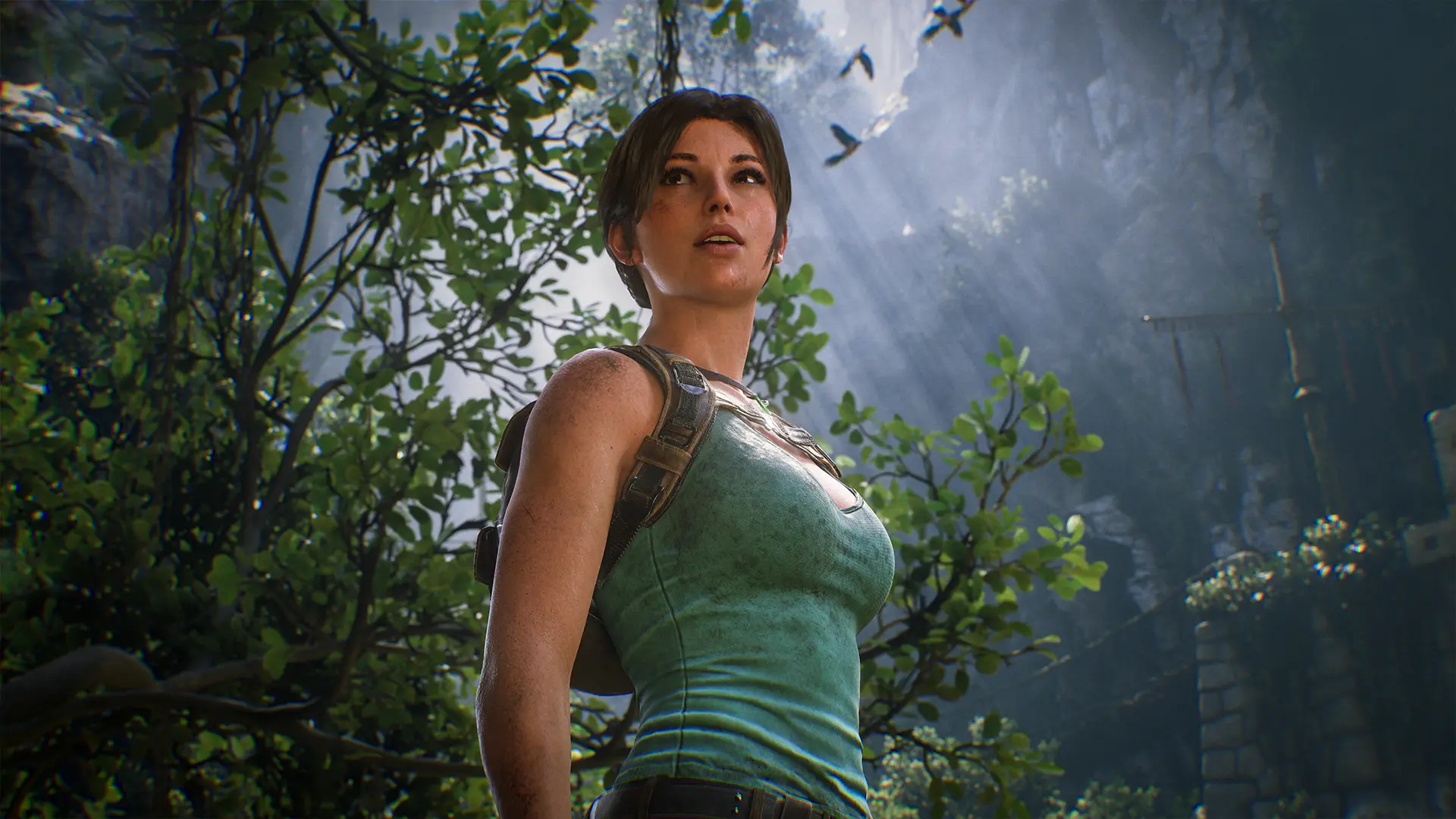
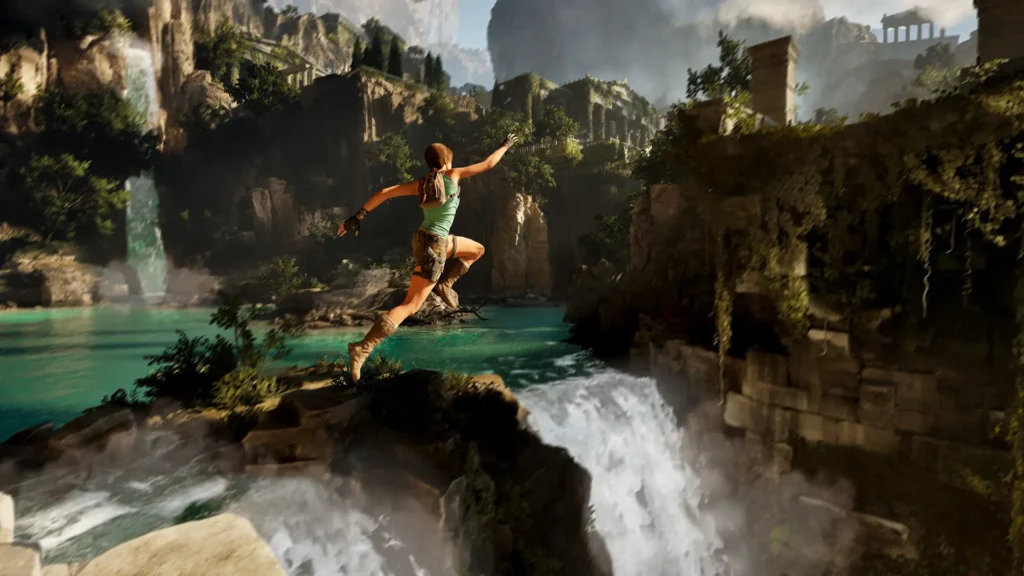
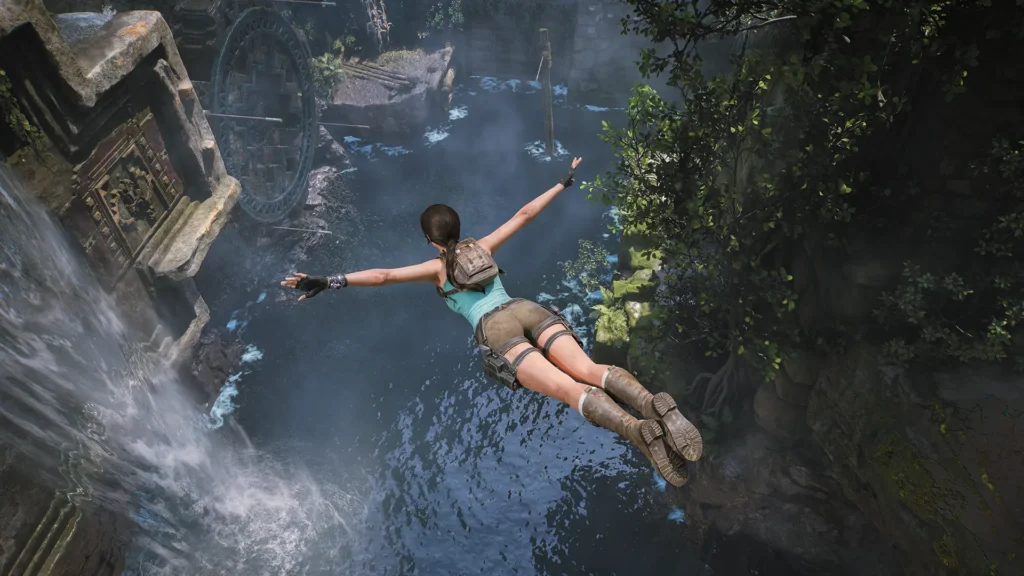
But what I find instead, as I sit down at my station and pick up the provided DualSense controller, is exasperation. The opening, sweeping cinematic shots of this reimagined version of the original Tomb Raider’s Lost Valley level should be a feast for the eyes, and by all rights they are, but my eyes are preoccupied. I find myself almost involuntarily scanning every pixel on-screen, studying the incidental details and textures to see if I can spot any AI weirdness. Not as some kind of “gotcha,” I already know that generative AI has been used in some way during production and so this in-development build may well contain non-final assets.
No, at this point it’s somewhere between morbid curiosity and a lurking anxiety. I think about how easily I could’ve sat in this very seat, played this very demo, and praised the undeniably lovely visuals I was seeing on-screen, completely unaware of the reality of its creation. That’s the thing with game development, there’s so much of it that is invisible in the final product. If what ends up in the final build is all “human-crafted,” then it’s up to a creative team to signal (or not) how it made it to that end point. It’s one thing to hold a fear of being duped by AI – social media has already introduced that lovely new wrinkle of participating in human society – it’s another to wonder if my integrity as a member of the games media could be undermined at any moment by accidentally praising some especially well-dressed slop.
And so I press on with the demo. I marvel at how well the team has realised the tone and feel of the original Tomb Raider in the context of a modern action game. I note that a degree of mid-2000s jank and idiosyncrasy has made it into Legacy of Atlantis, reminding me of my beloved Tomb Raider: Legend. It’s a refreshing shift from the “grit” of the survivor trilogy or exhausting earnest-ness of the Uncharted series. I wonder if an executive somewhere asked ChatGPT about what ingredients would make a successful, widely-liked new Tomb Raider game before green lighting this project. I’ve never wondered that about a game, but we’ve well and truly opened that conversation at this point.
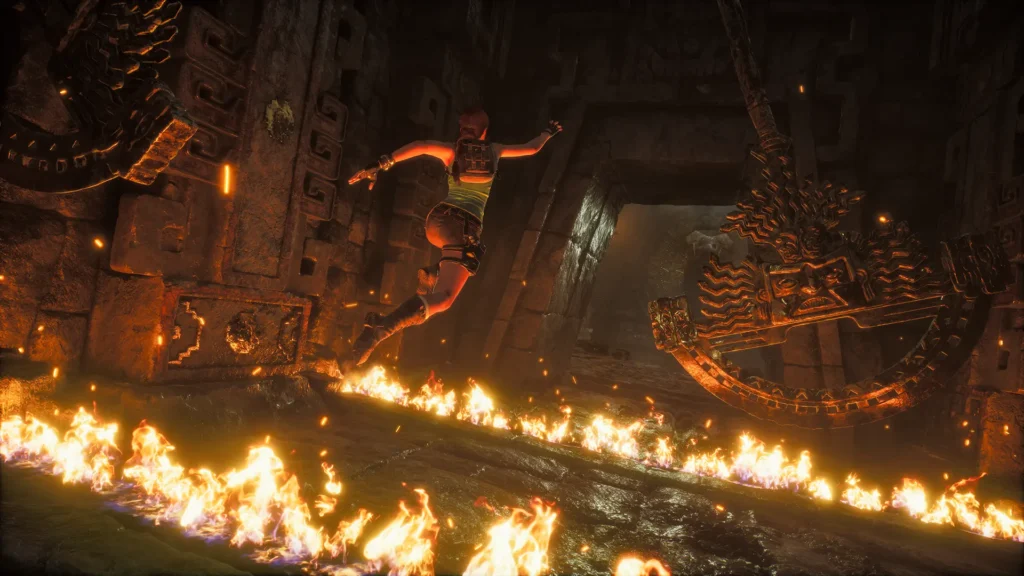
This roughly 30-40 minute demo takes us through some classic Tomb Raider environmental puzzles. Lots of climbing around, searching for hidden paths, releasing giant cogs from their ancient seats and then pulling them down-river to kickstart the mechanism controlling a huge, impassable gate. The design ethos of the early games has been augmented with features for the 2026 attention span – a scanner that highlights important interactibles in the world, hidden bits of lore to inspect and crafting materials to shove into the swelling pockets of your cargo shorts.
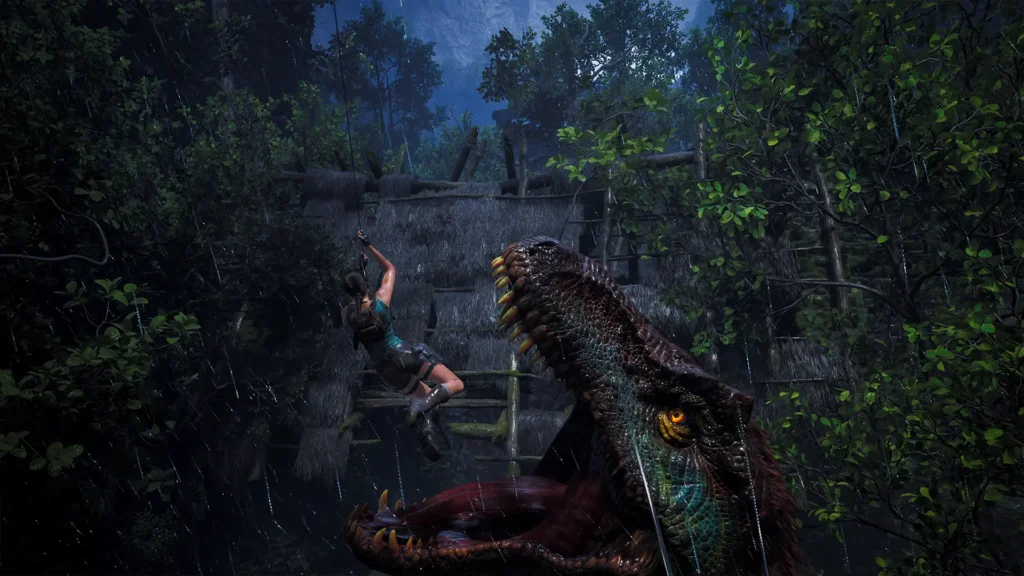
After solving the big cog puzzle, I’m introduced to combat against some velociraptors, which is fine enough, if a little clunky when it comes to dodge-rolling around tight quarters in the jungle clearing. When I start filling a focus gauge and popping up slow-motion tumbles where I can lay waste into dinosaur heads with my twin pistols, things start to pick up. But not before the showpiece moment comes along and I’m suddenly barreling across these ancient ruins and twisting, unkempt landscapes in pursuit by a huge T-Rex. It’s another glorious bit of 90s/2000s era action platforming that I genuinely get a kick out of.
“Does this T-Rex design look a bit weird to you?” the person at the station next to mine asks, “Like a bit…?” I don’t think it’s responsible to just point at things and say “AI”, but it’s clear the AI-nxiety has gotten them, too.
I envy those that don’t consume video game criticism or reporting, that don’t engage in communities where this information is discussed and debated, or those that simply don’t care. They can buy and play Tomb Raider: Legacy of Atlantis and, if my time with this preview build is any suggestion, they’ll probably have a very decent time with it. I want to believe Crystal Dynamics when it says that all of the final assets in the game will be made in the traditional way, by humans, but even if the sleuths of the internet pore over every pixel and turn up nothing, we know for a fact that it’s not the whole story.
I can’t speak on the future of genAI in the gaming landscape. Whether we’ll have the proper language to speak about it, or if merely enjoying a video game will be possible without capitulating. I can’t even promise that I’ll hold the same convictions that I do now.
I wear down easy.
What I can say for now, is that it’s simply not possible to fully appreciate a game that I know for a fact includes genAI as part of its development pipeline. No matter how much it otherwise gives me excitement, enjoyment or even enlightenment, the bitter aftertaste simply isn’t worth a fleeting sweetness. And while I could choose to be ignorant, to “like things for what they are,” I think it’s important I continue to feel this way, for as long as I can.