

Generative upscaling technologies like DLSS, FSR and PSSR have quickly become ubiquitous in video games, and for good reason. The technology allows developers to capitalise on the performance gains made by rendering at sub-4K resolutions and then have a machine learning algorithm boost it back up with very convincing results, and it opens the doors for players to do more with less when it comes to their gaming rig of choice.
And until now, all of that has felt appropriately distant from the other side of generative AI technologies – the one that guzzles natural resources and steals art in the name of so-called “slop” content.
Enter NVIDIA, which has today unveiled the latest iteration of its DLSS technology, dubbed DLSS 5. The new whole number is there to denote a radical shift in what the company’s cutting-edge technology is capable of, but this is one major upgrade that has sent the internet into a frenzy for all of the wrong reasons. So what’s happened, here? Let’s explore.
NVIDIA DLSS 5 – The pitch
“Today I’m going to show you something of the future. This is our next generation of graphics technology. We call it neural rendering, the fusion of 3D graphics and artificial intelligence. This is DLSS 5. Take a look at it.”
That’s NVIDIA’s CEO Jensen Huang introducing DLSS 5 during the company’s GTC 2026 keynote, describing a technology that marries the highly structured real-time 3D visuals we’re used to today with the ‘photo-real’ probabilistic rendering of AI to produce what it wants us to believe is the ‘nest generation’ of graphics.
The goal is to jump years ahead in the representation of lighting in real-time graphics by taking all of the existing information from a scene and pumping it through DLSS 5 to figure out the most hyper-realistic version of each frame according to machine learning, shifting the paradigm from complex and hardware-intensive lighting calculations done by the game engine and palming the work off to neural networks to paint over each frame in real-time.
NVIDIA DLSS 5 – The reality
And if you’re reading this and already starting to put the pieces together then, yes, you are correct. DLSS 5 makes it look like NVIDIA ran all of your favourite games through Google Gemini with the prompt “everyone here should be more realistic and hot.”
There are flickers of a good idea here, at least if you’re someone who values realism over artistic intent. In the example video below you can see some familiar games exhibit some astonishingly convincing environments that simply wouldn’t be possible with traditional rendering tech, but even if somehow that’s an exciting prospect to you, I urge you to stop and look at what it’s doing to the characters:
To lead with Resident Evil Requiem‘s Grace Ashcroft as the poster example here is…baffling. This is all of those ‘yassified’ video game memes that were birthed from that one, incredibly misguided attempt at ‘fixing’ Horizon Zero Dawn‘s Aloy, only a company worth $4.3 trillion thinks it’s something you actually want.
According to Digital Foundry’s uncharacteristically sycophantic reporting, DLSS 5 takes only colour information and motion vectors to process the image into something you’d see in a ‘Nintendo hire this man!’ post, with all geometry, textures and materials remaining untouched aside from the improvements in lighting. That feels confoundingly false, though, when you actually look at the results. The video shows a few character examples, each more ghoulish than the last, but sticking with Grace for now there’s just no way this isn’t doing something else to the image. Her entire facial structure looks different, there’s the appearance of added makeup, she’s just not right and it’s searingly obvious.
NVIDIA DLSS 5 – The memes
But there is a silver lining amongst this chilling vision of a future that nobody asked for. The memes.
Yes, in the mere hours since the announcement happened and the first footage began circulating, the internet has responded in kind with an avalanche of incredible memes. I’m especially fond of the stuff coming out of the game dev community itself, big pockets of which seem just as perplexed as the rest of us. Here are some of my favourites so far:
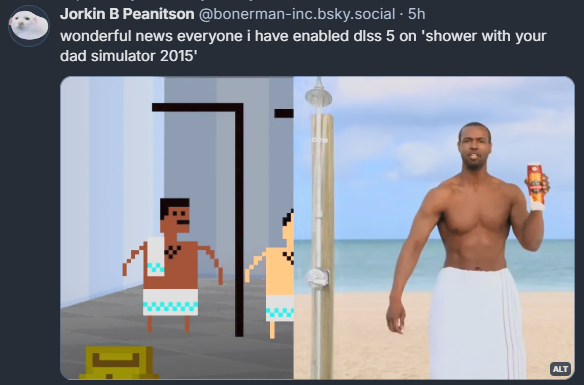
Please, keep ’em coming!
What do you think of DLSS 5? Is this the future you want? Let us know in the comments or on our social pages!