
Dynamic pricing, surge pricing, elastic pricing, whatever the flavour, we’re seeing an increase in big companies eschewing the traditional pricing structure of “you pay this much and we profit this much” interspersed with the occasional sale, and instead turning to an algorithmic model that determines the cost of a product or service that you see on checkout based on information gathered about you.
What is dynamic pricing?
We see it in things like Uber, where increased demand in a particular area or at a particular time drives prices upwards to encourage drivers to pick up more fares (or, more realistically, to boost revenue for Uber), or more recently in concert tickets where vendors have decided that the best way to stop scalpers is to become them, and of course it’s something airlines have done since the dawn of time.
And now, it looks like PlayStation is actively trialing a dynamic pricing scheme on the PlayStation Store, the virtual storefront where PlayStation owners are exclusively able to buy and download digital games.
Dynamic pricing on the PlayStation Store
This revelation comes via reporting from PS Prices, an online tracker of the pricing of digital games on multiple platforms’ storefronts, including of course the PlayStation Store. It says that, since November 2025, Sony has been running trials in a number of regions over a number of titles, displaying experimental discounts for certain users based on their placement in control or test groups.

Users in the test groups are seeing different prices to the standard tags seen by the control groups, usually at a discount over the regular retail price, and even include extra, personalised discounts over and above existing sale prices. The goal here, is for PlayStation to measure how this elastic pricing affects demand, and vice versa. The games enrolled in this testing hail both from Sony’s first-party publishing catalogue and some third-party partners.

Screenshots of information and charts belonging to PS Prices: https://psprices.com/news/sony-ab-testing-prices/
At first, this was reported to include about 50 games in 30 regions, but since an update this month is now up to 190 games over 70+ regions, including now the USA. Interestingly, the American trial seems to be offering the deepest discounts at up to 27.8% off, but also adds in a new wrinkle with some games in a seemingly separate bucket of the test including the potential for a price increase.
Update March 12, 2026: PS Prices has issued a correction on its reporting, noting that there was no price increase observed on the below. It had incorrectly listed one of the two tested sale prices as the “Regular Price,” causing the confusion and suggesting that Sony was testing dynamic price increases when it does not appear to be doing so.
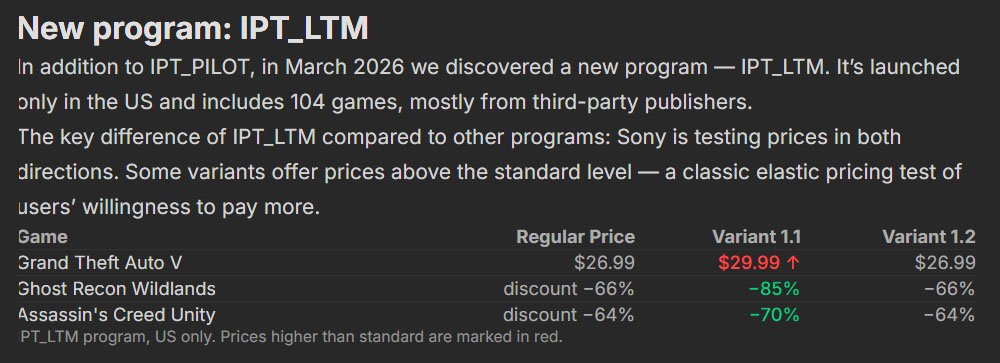
Screenshots of information and charts belonging to PS Prices: https://psprices.com/news/sony-ab-testing-prices/
The potential impact
It’s all really fascinating, and there’s an optimistic version of this out there that could give underrepresented games a better shot at sales by putting them out in front of the right players at the right price.
But it’s more realistic to see this as something of an ominous marker for how videogame pricing, or the pricing of consumer products in general, could go in the future. And it all comes back to the age of increased user information gathering and the market of metadata, where a company like PlayStation can scrape or buy enough of a profile on you that it’s able to predict exactly when you’re going to want to buy and play the latest God of War, and make sure it’s squeezing the maximum value its intelligence suggests that it can.
Of course, it’s important to remember that this is all hypotheticals right now, with PlayStation yet to actually address the trials or confirm PS Prices findings. You should definitely check out the report right here, to get the most clear picture of what we know so far.
What do you think about the possible advent of dynamic pricing on the PlayStation Store? Is this something that’s already affecting you? Let us know in the comments or on our social pages: