
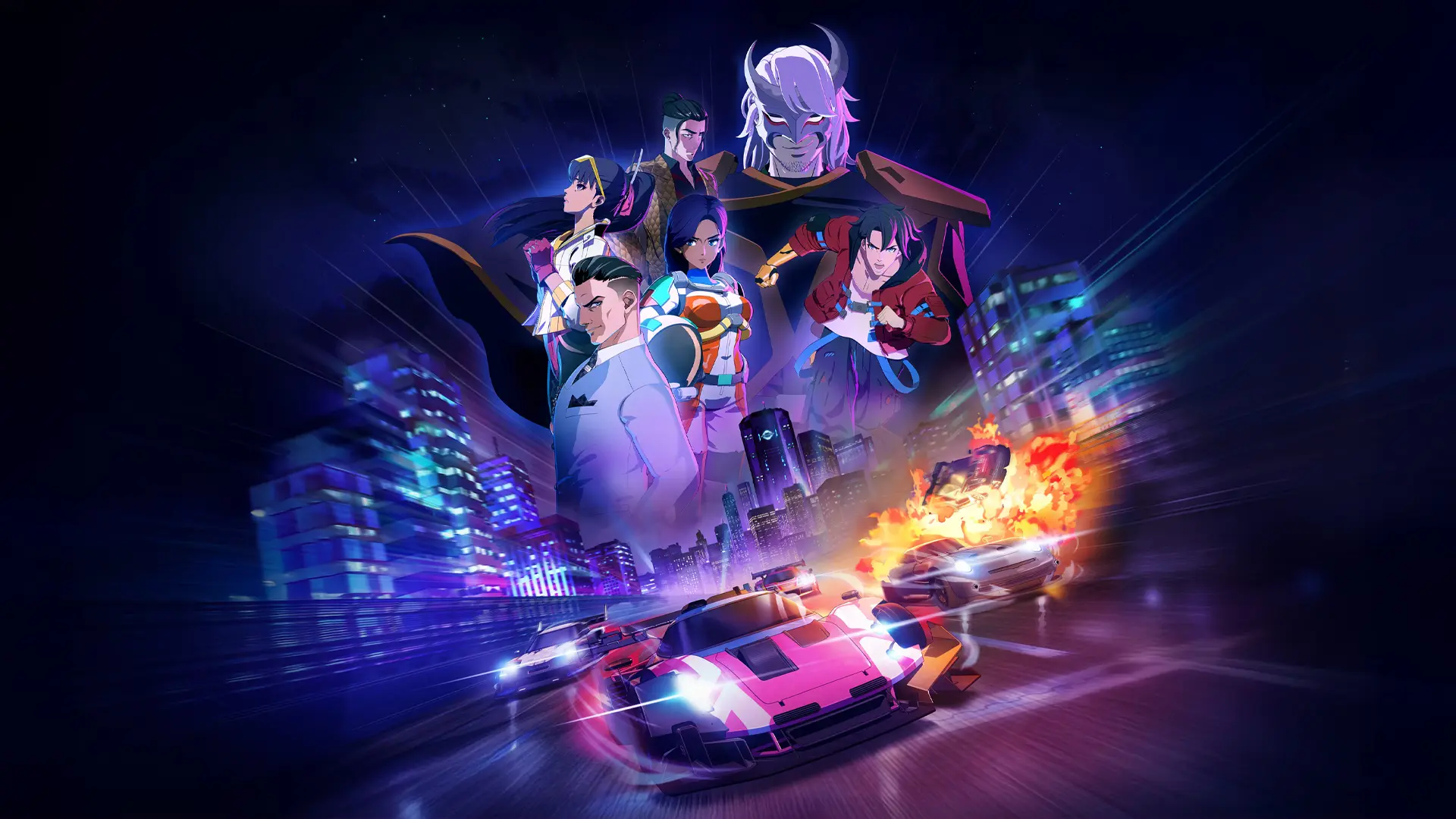
Now, I’ve never been much of a car person, or into motorsports at all. But I have watched enough Initial D and spent enough time in Tokyo arcades or playing golden-era Need for Speed for Screamer to speak to me. A return from Milestone to its own 90s arcade racing series of the same name, this new iteration of Screamer is unlike those early titles or really anything else I’ve played.
Screamer’s biggest success is in how effectively it brings together some surprising influences from in and outside the genre, to create some of the most exciting and technical arcade racing around. It’s not enough just to drive well in this game – you’ve got much more than the next turn ahead to keep track of at any given moment.
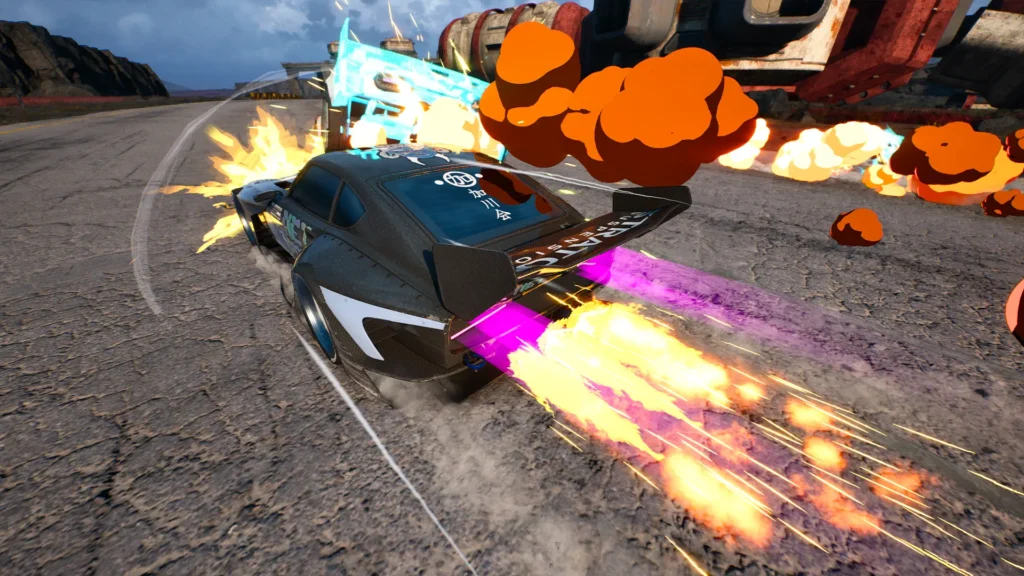
Just the fundamentals of driving are unique here. Drifting is performed not just tapping your brakes and turning into a bend with the left stick like any other racer, but also by moving the right stick to further augment the angle of your slide. It takes a minute to master, but once you realise the game is basically just asking you to put years of fruitlessly pivoting your whole controller through tight maneuvers as a psychological response into actual practice, it clicks. Shifting gears is equally eccentric, taking an unexpected cue from Gears of War’s Active Reload mechanic. Vehicles change gears automatically, but not right away, so hitting the L1 or equivalent button to shift up at exactly the right moments gets you there faster and contributes to your Sync gauge.
Sync is then spent on activating your Boost, which also has its own little timed button prompt to add extra time and power. And when you spend Sync, you fill up yet another bar. With enough chunks filled in, this Entropy gauge is how you activate a powerful Strike move that can explode any opponent you manage to collide with, or a short Shield burst that protects you from being on the receiving end of one. It sounds like a lot to keep track of while you’re also just trying to stay on-track and ahead of the pack – and it is – but once you can cross the mental threshold from playing Screamer like a racing game and playing it like a fighting game, you’ll truly start to enter what the kids call a ‘flow state.’
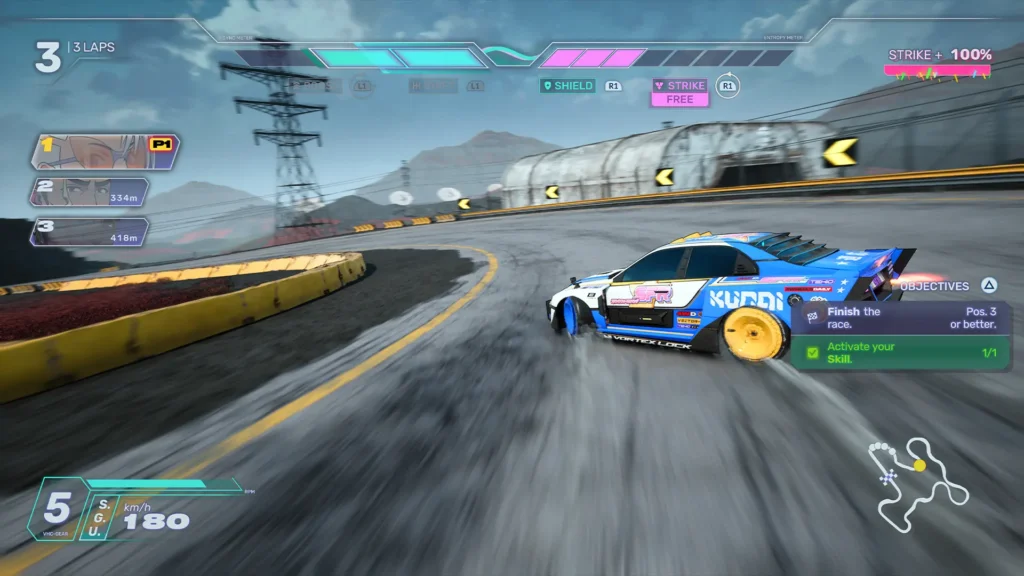
Add in Overdrive, a sort of ‘ultimate’ that turns your vehicle into a fire-y rocket that decimates rivals but becomes increasingly susceptible to self-combustion the longer it goes on, and there are as many ways to succeed in Screamer as there are to fail. I love everything about it, even when the friendly AI makes me lose a Team Race I was doing well in, or a bout of wonky collision physics ruins a run more than it should. I’m fully invested in learning the individual characteristics of each racer’s vehicle, which not only feel distinct but have their own quirks within the Sync/Entropy system.
The core single-player mode in Screamer is a story-heavy campaign dubbed The Tournament, and it’s where you’re introduced to the game’s eclectic roster and their various quirks. Chronicling the journey of these teams of racers as they enter and compete in a high-stakes competition funded by the mysterious and infinitely wealthy Mr. A (played by one Troy Baker), The Tournament is essentially an hours-long tutorial meant to very gradually introduce you to the complexities of the game as well as give you some attachment to its cast.

That’s all very good and fine in concept, but the execution just doesn’t cut it. There is some great stuff here – the anime inspiration shines through best in the occasional major cutscenes produced by Polygon Pictures, and I’m a big fan of the widely-international cast being voiced in their respective native tongues across the board. And once the story kicks into gear and the on-track action begins to heat up, it can be a blast. But there’s so much to get through before that happens.
Screamer spends a good portion of its campaign, multiple hours of it, explaining and overexplaining all of its racers’ backstories and relationships, all the while peppering the dozens of static dialogue sequences with thinly-veiled excuses for you to drive around a track a few times. It feels especially egregious early on, with the game taking ages to actually hand you any of the cool combat stuff, meaning you’re getting the least exciting version of Screamer’s otherwise fantastic driving for what’s easily more than half the runtime. It’s not until the final of its four story arcs, each with dozens of individual ‘episodes,’ that you’ll have been entrusted with the full suite of controls.
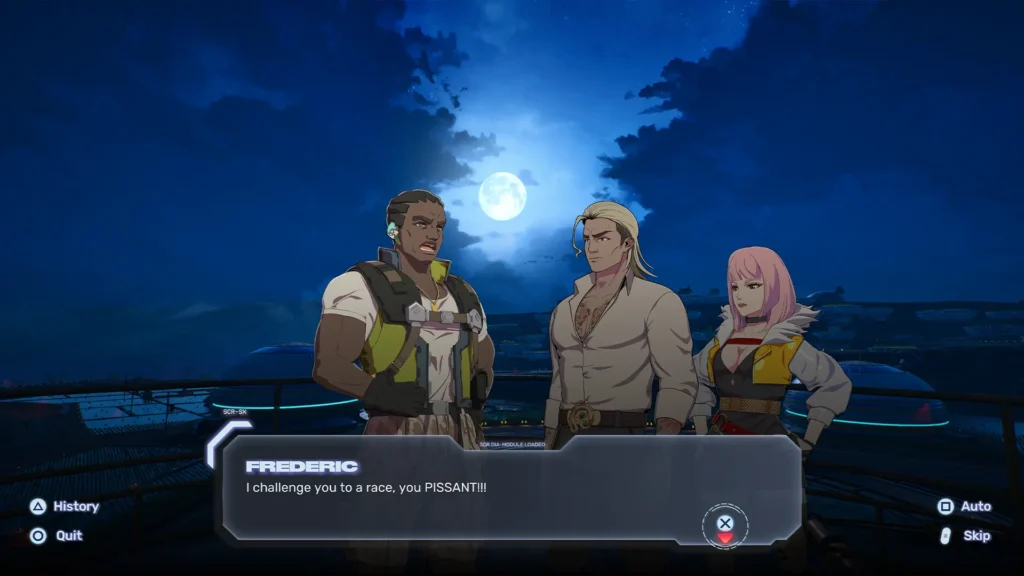
There’s also a massive disconnect between the game’s stylistic aspirations and the actual execution, especially when moving from conversation scenes to the track. Despite the slow start, there’s a lot of the underdogs fighting the power and personal tensions spilling over into cutthroat competition vibe that makes these types of stories fun, but all of that goes out the window once a race starts. Outside of some bespoke moments, there’s no back and forth between friendly or rival racers on the track, there’s none of the storytelling or drama that carries into actual play, and it’s jarring.
Even the visual presentation – more of the typical, realism-lite 3D visuals that other arcade racers employ – feels too far from the presentation elsewhere. It’s hard not to imagine how much more thrilling and compelling races would be with a cel-shaded aesthetic to match the cutscenes and more energy coming from the characters we’re supposed to be engaging with. The individual car designs are killer, but they can’t do all of the lifting to save the rest from being pretty bland.
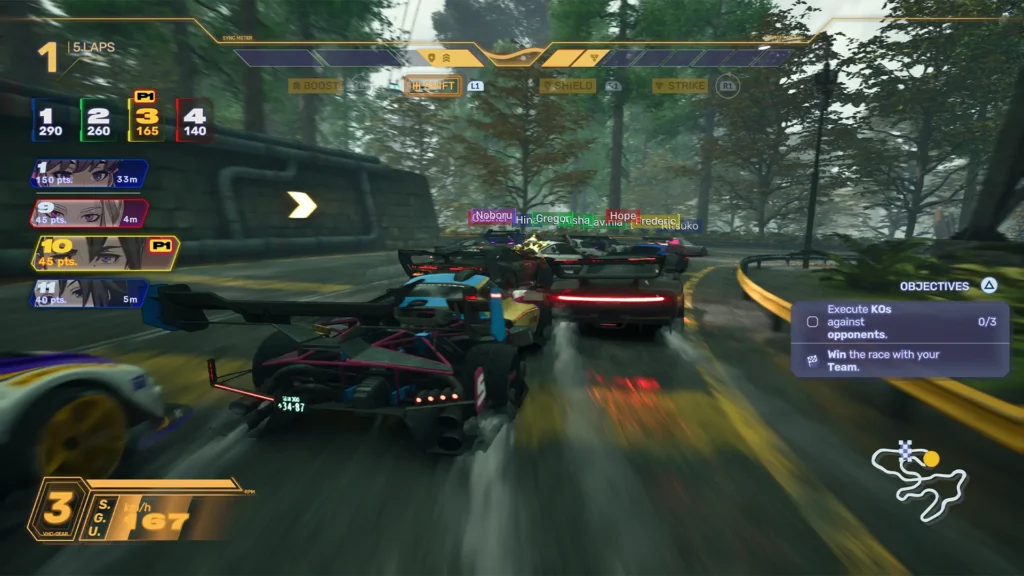
The core suite of modes is otherwise decent, offering a few novel ways to play and truly push yourself against the game’s systems. I spent quite a bit of time trying to master Checkpoint races, the leaderboard-focused Score Challenges and the true test – a mode that puts you permanently in Overdrive and simply asks you to survive as long as you can. For me? Not long.
There’s also a full complement of multiplayer options, including up to four-player splitscreen and a mix of ranked and casual online lobbies. The latter wasn’t something I was able to check out ahead of penning this review, nor am I overly interested in out of respect for how high the skill ceiling in this game is and how far I am from reaching it.
Reviewed on PS5 Pro | Review copy supplied by publisher