
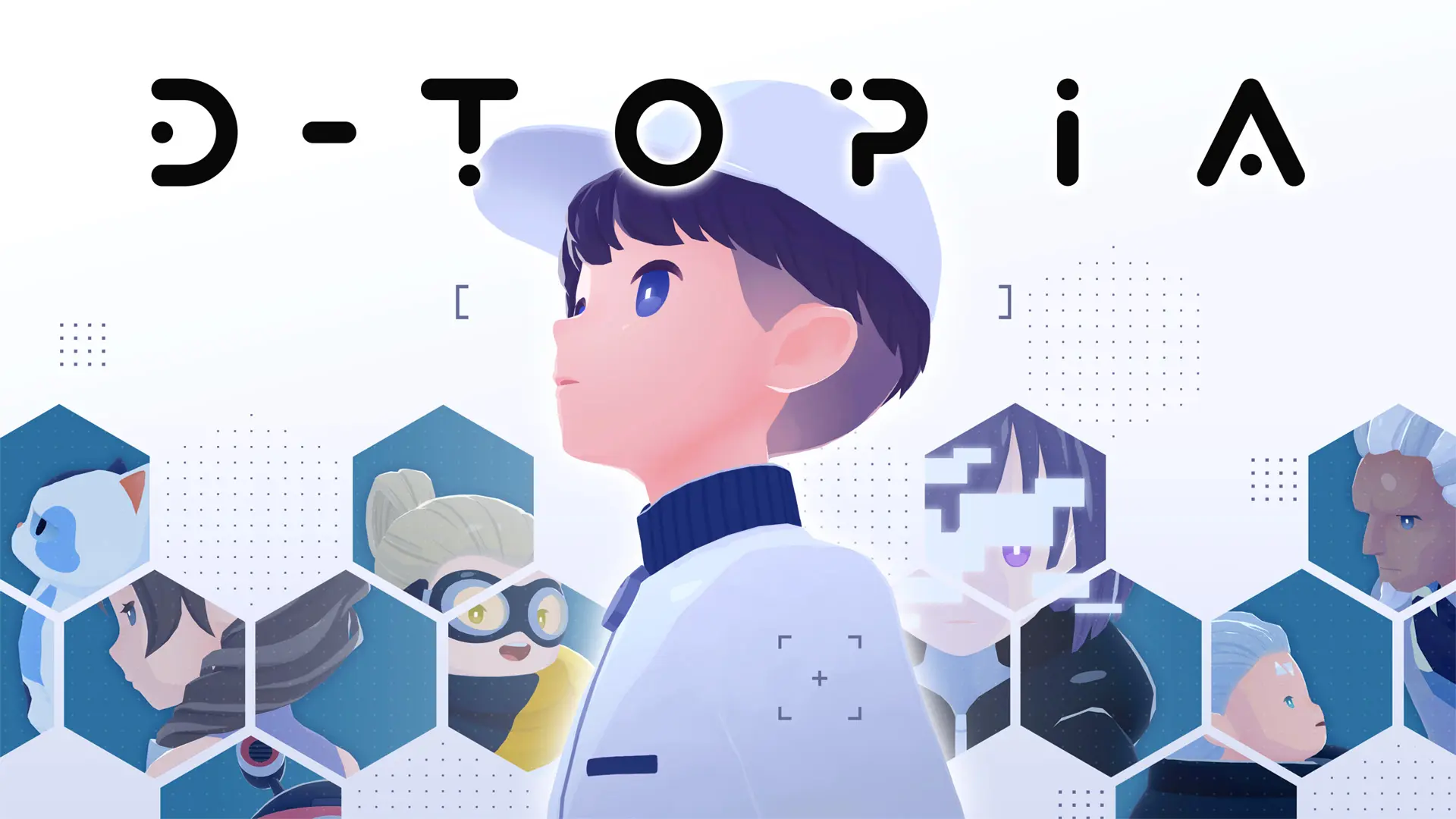
D-topia imagines a world where humanity has long since hit its lowest lows, the kind required to prompt a bold new direction for the future. That new direction is the Utopia Project, created to bring “The greatest happiness to the greatest number of people” by leveraging AI, genetic engineering, synthetic environments and social algorithms, and D-topia is just one district of many in an ongoing testbed for the perfect human society. Billed as the closest model to the final form of the project, it represents the result of incredibly precise assignment and the utter rejection of imperfection.
Shiro arrives here as a newly-hired Facilitator – a unique role in D-topia that simply asks him to look out for his peers and be ready to help out with any and all situations that might arise. Gifted a comfortable place to stay, free regular meals and with any other needs anticipated by the AI overseer that keeps the entire community running, it hardly seems the type of place to need an extra caretaker, but humans being humans that idea is quickly cast aside.
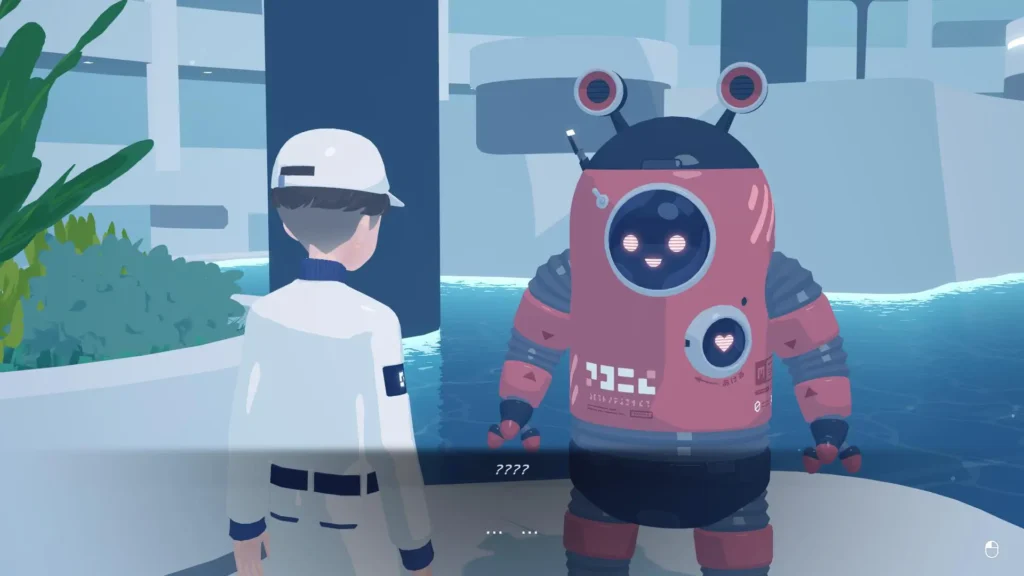
Played out over the course of a week, it’s not long before Shiro’s role in D-topia – and its very societal fabric – are tested. How he navigates each new challenge and responds to the needs of his fellow D-topians forms the player-driven core of the game, and determines the course of its branching narrative paths, as well as its final conclusion.
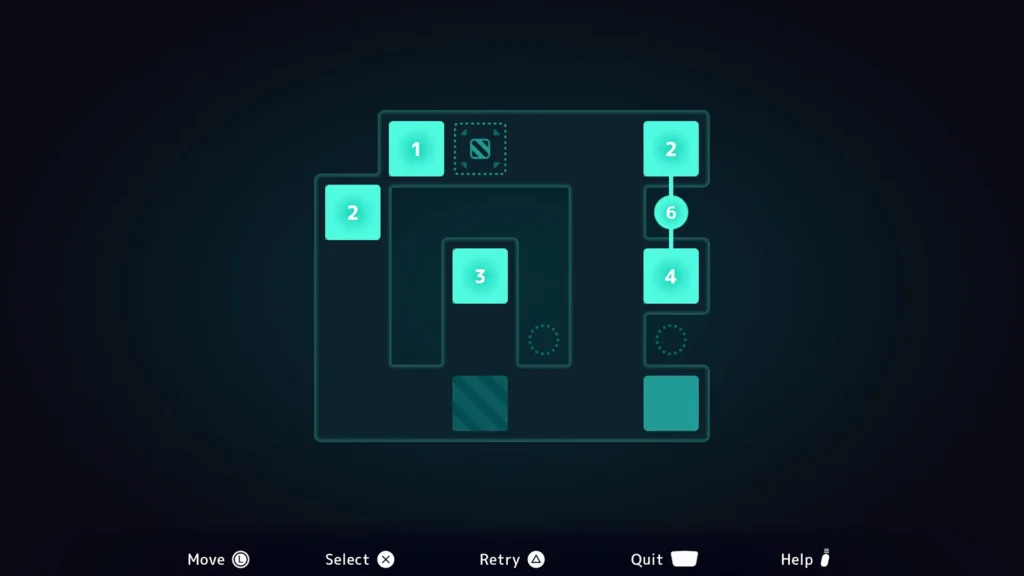
The bulk of how this all plays out is through work and relationships. Shiro’s days typically involve a bit of prescribed labour involving solving sequences of puzzles (which are fun!), but outside of this his time is spent getting to understand his new home and form bonds with some of the more interesting residents of D-topia. With enough time and trust-building, measured in-game as an Affinity metric, each of these key characters eventually entrusts Shiro with a concern of some kind. These range from battling creative block to feeling disenfranchised with the status quo, suffering imposter syndrome and more besides, but all essentially come back to the weight of expectation – a weight borne of this system that assumes perfection in the pursuit of happiness.
D-topia’s bright, airy architecture, friendly “Troids” and perfect ambience slowly reveals itself to be a facade, and as events move along you’ll see more of the reality that underpins it. Everything that humans experience here is filtered through a visual network that blocks out the unsightly and replaces it with the perfect. Your Facilitator’s unique privilege to access the Block Side reveals the truth – a cold, dark sea of bare metal and concrete, the humming and clanging of machines, the “floating” helper bots that are actually just boxes on steel arms. This unprecedented level of access gives Shiro the means to help in ways as small as fixing a signboard, or have ramifications large enough to affect the destiny of the entire Utopia Project.
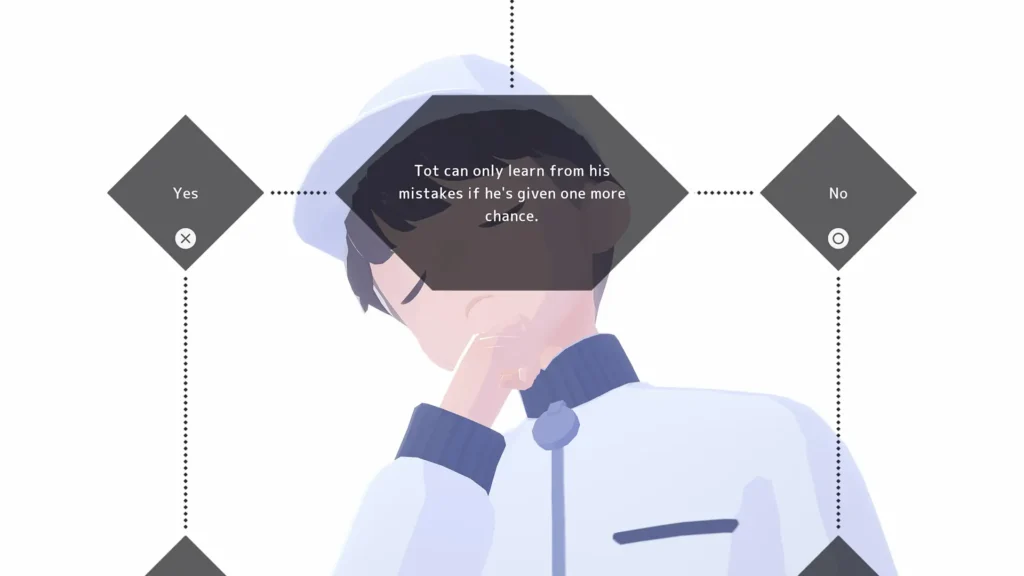
A lot of the big decisions made here come via “Brain Meetings,” a minigame wherein Shiro’s inner dialogue is presented like a flowchart, and asks the player basic questions about the predicament in front of them to help come to an answer. Questions range from basic observations to establishing your very moral and sociological views on a topic, and this system of working your way up to what would typically be a simple list of answers in another choice-based narrative game is quite novel. As someone who admittedly spends far too much time agonising on what my choices in games might lead to, it’s good to have the focus squared directly on what I actually believe. And trust that some of the choices you’ll be faced with are… a lot.
The beauty of D-topia is that it understands how this can work to its benefit, telling a short-form story with a concise message but giving the player freedom to engage in ways that affirm or provoke their own ideas. Compared to something like sculpture or novel or film, simply asking the viewer to leave with the artist’s message and dissect it after the fact, it allows us to accept or reject its ideas in the moment, and it has the tools to push back with its own thesis.
The game has multiple endings, that are pretty clearly defined as “good,” “bad” or simply ambiguous, which at first I felt might be a mistake, diluting the authors’ ability to form a clear statement, but in fact it’s the opposite. A “bad” ending is not a failure of the viewer or the work, in the way that interpreting differently or disagreeing with art doesn’t invalidate it or us, if anything it’s exactly the point. The ambiguous conclusion turned out to be the one I felt most compelled by, and unsurprisingly was the one I achieved first and by simply ignoring that “winning” the game was possible, making the decisions and spending the time where I felt was right.
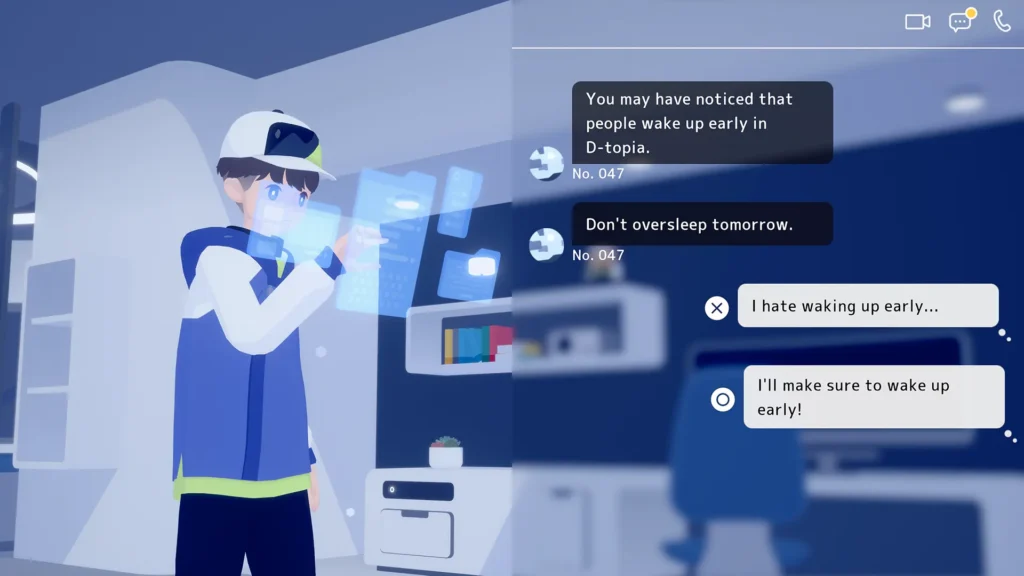
You could take any number of messages from it, but for me, D-topia largely ponders what AI and algorithms can tell us about art, about humanity, and more important what they can’t and where the creep of bias ultimately undermines any egalitarian purpose. It isn’t explicitly “anti,” either, if anything wholeheartedly entertaining the notion of a future where algorithms have determined a society in some form of equilibrium – but in doing so quite deftly pointing out where that notion is easily dismantled by human observation. What’s correct and what’s right are not the same, after all.
I can appreciate that it is quite direct about human vs AI art, though, carving out whole character storylines to express how our past experiences, current state of mind and visions of the future inform art, and how without those things AI cannot truly create art – and perhaps even more importantly it does not have the ability to start or stop creating of its own volition.
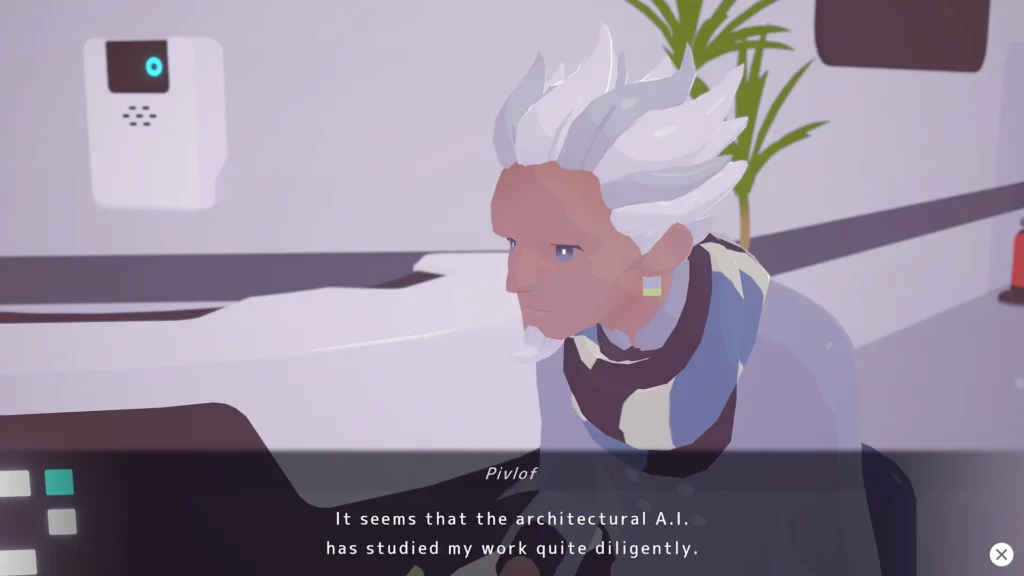
The other thing that’s especially effective about D-Topia is that, for all of this existential musing and cautionary messaging, it’s also quite lovely and charming a lot of the time. It’s almost like soft dystopia, an invitation to those who prefer their media cute and “cosy” over edgy and challenging, to exist in the same well of despair as the rest of us. Each day moves at a gentle pace, and there’s plenty of escapism into a world where one’s needs are met (it can happen!). The Block Side becomes as confronting as it is because of this, as well. That might seem like a cruel trick, but this game is far too earnest to be sinister – it’s simply proof that fun, and beauty, need not be detached from thought.
A work like D-topia is hard to review in a traditional sense, because in doing so I’m supposed to tell you whether or not I think it’s “good” in a way that’s quantifiable. But this is a game that explicitly challenges whether goodness, or perfection, could ever be quantified in a genuinely meaningful way. Thankfully, I can also use this form and these parameters to simply recommend you play this game. And I do, wholeheartedly, recommend you play D-topia.
Reviewed on PS5 Pro | Review copy supplied by publisher


Born into the world of video games through SEGA, and in particular Sonic the Hedgehog, Kieron’s gaming tastes now consist of the latest, shiny AAA thing, an indie darling or two, and an embarrassing number of hours of Balatro.