
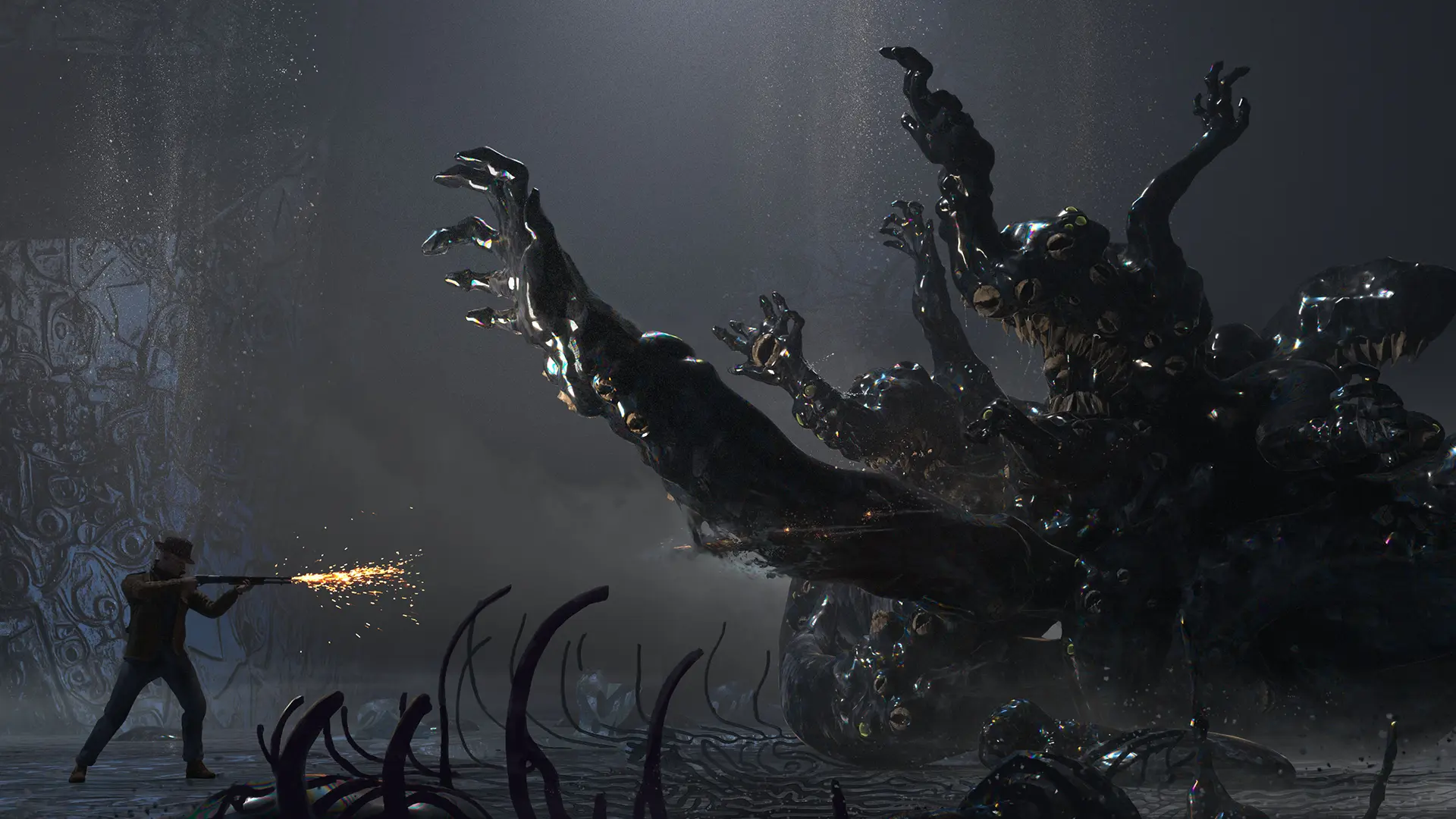
I’m currently playing The Sinking City 2 for review, and while a review embargo is still in place until August 18 at 1AM AEST (August 17 at 5PM CEST), Ukrainian developer Frogwares has been kind enough to chat briefly with me about one crucial aspect of the game – that it was made entirely during Russia’s ongoing invasion of and war against Ukraine.
That’s not exactly a revelation, of course, but a message that appears every single time The Sinking City 2 is booted up really drives the point home. It also prompted me to reach out and ask the team if they’d mind sharing a bit more about what keeps them grounded and creating under such uncertain circumstances, and what it means that The Sinking City 2’s development was even possible.
But first, here’s the message as it is in the game (alt text provided):
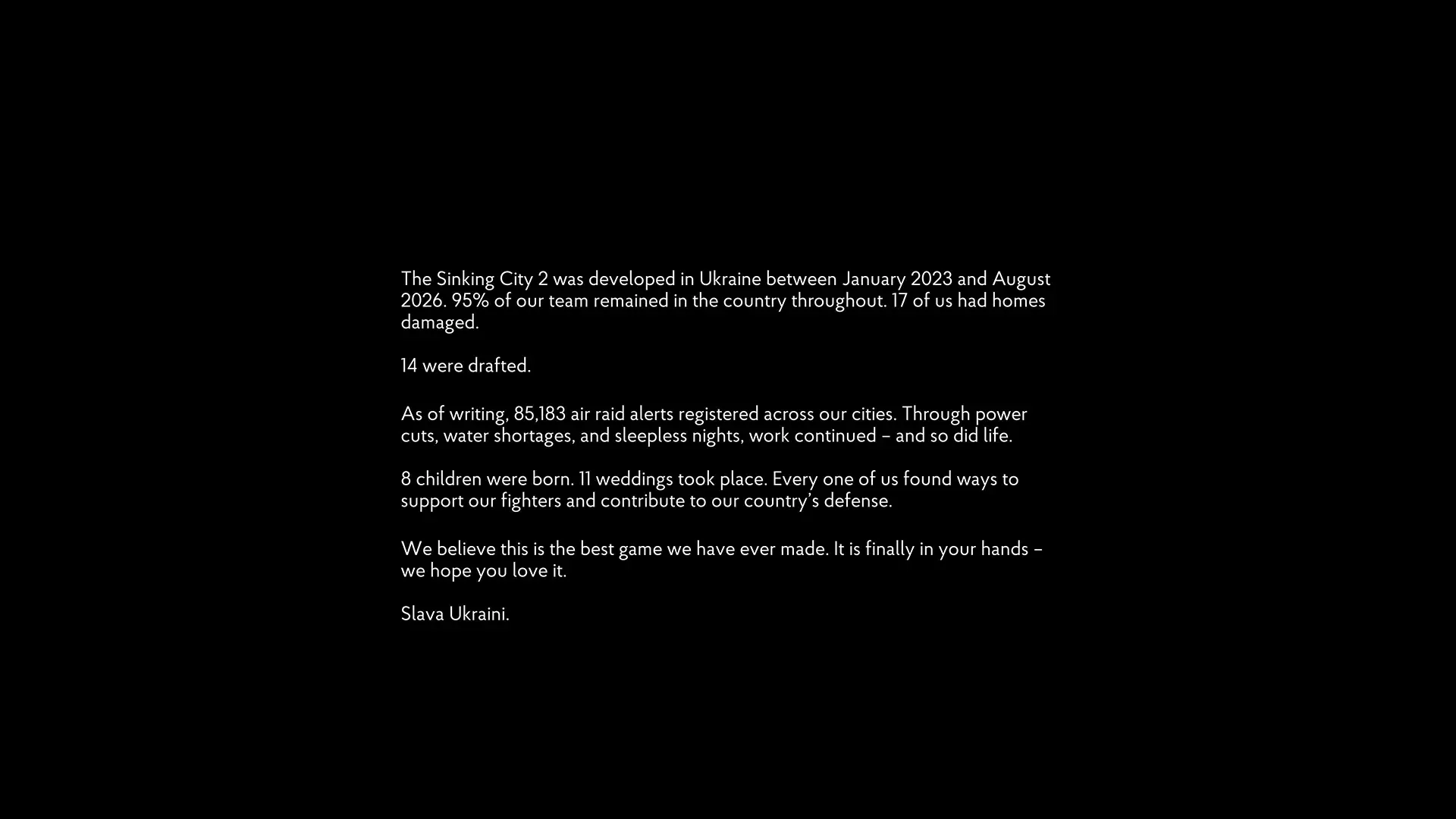
Another message also reads, “A sincere thank you to all our supporters for your belief in our vision, and for helping bring this project to fruition in these troubled times.”
It’s not the kind of thing you’d expect to read just before booting into a Lovecraftian survival horror game, but it bears taking in and it immediately brings a level of context and connection that games are often missing. As someone who’s spent years writing video game criticism, it’s all too easy to disconnect yourself from the circumstances of a work or its creators, so Frogwares giving every player the opportunity to go in with some understanding of what it took just to get them to this point feels important.
“Ukraine is our home. A lot of us want to stay here, and for obvious reasons, many of us also have to stay here,” the studio told me when I asked what keeps them grounded and creating amidst all of this uncertainty and these challenges. “But being able to continue creating and working gives us some semblance of normality. We can focus on making something, on solving problems, on working together with our teammates. In a situation where so much of your life can feel completely outside your control, having something you can build together becomes incredibly important.”
It’s a frame of mind that I’m sure many in game development can say they share, and one hell of an argument for why protecting and furthering the arts should be one of our greatest interests as a community. Whether it’s financial crises, the advent of job and art-destroying technologies, the erosion of access and ownership or, in this extreme case, invasion and conflict, it’s not just the consumption of art that enriches us but also the creation.
And while The Sinking City 2’s dark, cosmic horror atmosphere might not bear immediate parallels to Frogwares’ own situation, it’s certainly not all that far removed. I was interested in how players might be able to connect to the studio’s position and outlook through the game, if at all.
“Not to sound too dramatic, but in some ways it’s almost easier to work on something dark and depressing when you’re not particularly far removed from those feelings yourself. When you’re surrounded by that kind of atmosphere, or experiencing it in your own life, you inevitably bring some of those feelings, thoughts and emotions into what you create,” the team described.
“So yes, there is definitely a part of us in The Sinking City 2. We didn’t set out to make the game a reflection of the war, and the story is very much its own thing, but the circumstances we’ve been living through have inevitably influenced how we approach certain themes and how we portray things like fear, isolation and uncertainty.
“There are also a few places where reality has made its way directly into the game,” the studio reveals. “The emergency siren, for example, is an actual recording of the air raid sirens we hear here in Ukraine before an attack. It’s something that has become an unfortunately familiar sound for us.
Without the privilege of context, one sound effect used during the game’s intro would have likely given me no pause, but instead it now plays back in my mind. The way I feel about it couldn’t have happened unless a human being recorded that sound and put it there. This seemingly ordinary bit of audio only exists because a group of artists came together and someone saw the opportunity, and was empowered, to put their own experience into that moment.
“There’s also a section in the hospital featuring what, to keep it vague, we’ll call “testimonials.” I don’t want to go into exactly what they relate to, for obvious reasons, but those are from real people and their real experience from the front.”
“These elements aren’t there to make some grand statement about the war. They’re there because this is the reality our team has been living in while making the game, so it’s what’s on our minds.”
Being self-published means that Frogwares is in complete control of its messaging, but it’s surely not an easy path, especially when stability is a luxury. And so the studio turned to Kickstarter to not only ensure they get The Sinking City 2 across the line, but to protect that stability and provide security to the team. The Kickstarter wound up being a resounding success, meeting its initial €100,000 goal in under two hours and going on to reach a total of €554,002 pledged.
“The response to the Kickstarter was incredibly important to us, not just financially, but because it showed us that there were a lot of people who believed in what we were doing. We were taking a risk by moving The Sinking City into a very different genre, and having thousands of people essentially tell us, “We see what you’re trying to do, and we want it,” gave us a huge amount of confidence that the risk was worth taking.
“Of course, the funding itself gave us an immediate safety net. It allowed us to expand the game with more content, bring additional teammates onto the project, provide equipment where it was needed, and even help with some relocations within Ukraine as people had to leave areas that had become increasingly dangerous.
“So it wasn’t just about making the game bigger. It gave us some additional stability at a time when stability is something we’ve often had very little of.”
This section from the review guide sent out to press currently playing the game really puts into perspectives the lengths the team has had to go to, and the challenges its had to overcome, to get The Sinking City 2 out there:
“Many times, someone would be working with us one day and then be conscripted the next, leaving a gap in the team. And every time, we had to adapt to the changed situation in the team, and every time, we worried about the safety of these people. Some people moved to places far outside the major cities to be safer from attacks. The fear of losing one’s life or family affects everyone differently and can push people to avoid travel and prefer staying confined.
“As a result, not once in the 43 months of production has the studio’s management been able to meet in person, let alone the entire team. Instead of being able to gather in a creative context to talk, formally or informally, we often had to move forward, in the dark, using mobile internet, getting the most out of our video calls by presenting our work and exchanging ideas when the situation allowed. In this situation, any hesitation could disrupt the schedule, any mistake could threaten the whole project. It took immense effort to create and finalize the game to submit for certification.”
The Steam page for The Sinking City 2 proudly displays a “MADE IN UKRAINE” graphic, emboldened by the colours of the country’s flag. And while the game itself is set in a fictional, 1920s Massachusetts city – one beset by Lovecraftian monsters and cosmic horrors – those three words couldn’t be more significant. It not only tells you that The Sinking City 2’s very existence is a miracle, created entirely in the midst of very real horrors, it tells you that it was made by humans. Humans that work, that sleep, get married, have children. Humans that lose loved ones, homes and livelihoods. Humans that make art.
“We won’t have a release party for TSC2, it’s not possible. There won’t be that moment to gather, to talk, to reminisce, to see each other, to bond over our troubles and our hopes, something that feels more necessary than ever.
“After nearly four years spent on this game, we’re all hoping for a strong launch, to reach new and old players, and to be proud of what we created here to show the world. This is how we fought, for our lives and for our craft.”
This piece includes quotes from The Sinking City 2’s review guide as well as direct statements given to covergeek. A special thanks to the Frogwares team for offering their limited time to provide these.
The Sinking City 2 releases on August 18, 2026 for PS5, Xbox Series X|S and PC.

Born into the world of video games through SEGA, and in particular Sonic the Hedgehog, Kieron’s gaming tastes now consist of the latest, shiny AAA thing, an indie darling or two, and an embarrassing number of hours of Balatro.