
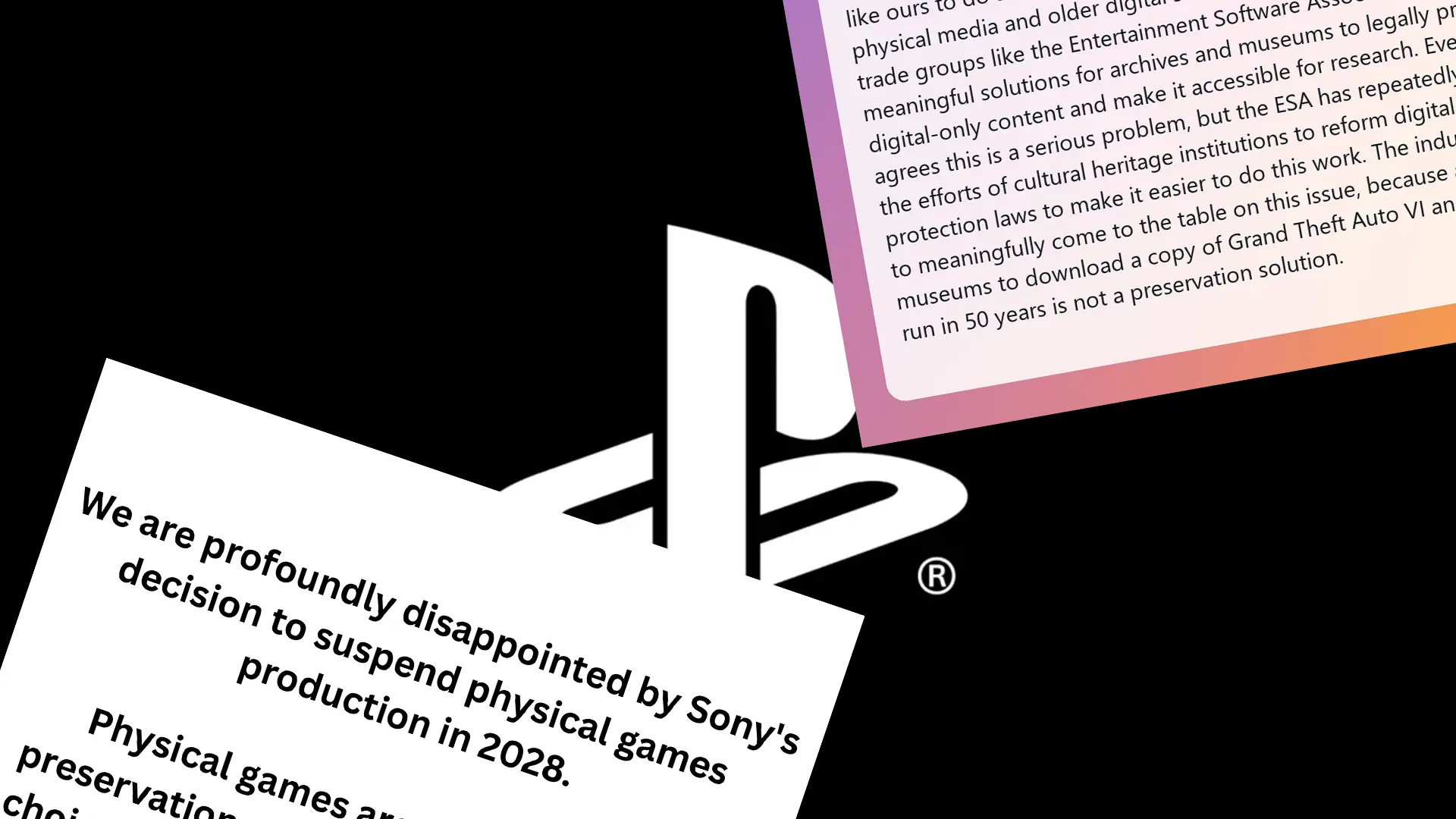
You don’t have to look far into the gaming-focused corners of the web right now to see folks heavily discussing and debating the implications of last night’s announcement that PlayStation will cease producing physical discs for all first and third-party games beginning January 2028.
And for good reason – it’s a nuanced enough topic on its own, but it’s also come at a time where anxiety around the future of video games as a medium is at an all-time high. Studio closures and layoffs, skyrocketing hardware prices and the advent of genAI (which has contributed to both of those things) – it’s generally just a pretty grim time to be a gamer, especially one that cares to pay attention to the workings of the industry and the many hundred of thousands of creative hands that make it all happen.
This PlayStation news not only speaks to similar issues of inflating costs, but also the hastening erosion of access and ownership that’s long been brewing since media as a whole has fully embraced an online ecosystem of digital delivery. The idea of “owning” any game, or film or piece of music that we buy is all but finished, and with it a significant entry point for those without the means to buy in at full price or feasibly get onto the internet. These are things that, as much as you or I may say “I buy all my stuff digitally already,” we should all be thinking and talking about.
The other major, longstanding issue in the industry we all enjoy the fruits of, that this development interfaces with quite crucially, is that of game preservation. It’s a field that is already fraught with difficulty for numerous reasons, particularly because there just isn’t a ton of governance of game studios and publishers to make their materials available for academic purposes. But any effort to preserve a video game work for future generations to have access to becomes that much more improbable without physical media to rely on. It’s a loss not just for those who might want to revisit and play a cherished title from years past, but for researchers, artists, anyone who might want to look at these titles as a study – like we do with so many other forms of art.
So what are those in the field of video game preservation saying about PlayStation’s recent decision? We’ve taken a look online at some of the statements, anecdotes and observations from the organisations and individuals most knowledgeable on its impact and explored for you here the ones we think are the most important and impactful:
What are game preservationists saying about PlayStation’s end to physical discs?
First we have this statement from the Video Game History Foundation, which is a non-profit that dedicates itself to preserving, celebrating, and teaching the history of video games and hosts a free, publicly-available digital archive of industry documents, magazines, transcripts, and more right here.
VGHF director, Frank Cifaldi, speaks to both the end of PlayStation discs and the simultaneous disclosure from PlayStation that it’s closing the PS3 and PS Vita digital stores across the globe by July 2027. Cifaldi notes the impact of these changes on consumers, as far as their innate rights and the market’s ability to trade in physical channels, but actually downplays its significance on game preservation.
That might sound somewhat positive, but unfortunately the reality is more bleak. Cifaldi explains that, actually, game preservation has been a rough gig for just about the past two decades given the existing prevalence of digital delivery, and especially the incredibly democratic world of PC game development and distribution. And, the statement continues, even when console games are made available physically there’s a whole ecosystem of day-one patches and rolling updates that means properly preserving a game the way it was in any given moment of time is a tall order.
The director assures that museums and archives have been preparing for this inevitable, digital-only future for a while for these exact reasons, but expresses frustration with the broader industry for expecting these organisations to do all of that work unaided. He calls for trade groups like the Entertainment Software Association (ESA) to come up with actual guidelines and meaningful solutions, noting that the ESA has been unwilling to come to the table with regards to existing digital copy protection laws that severely impede third-party archival efforts.
The statement ends by saying, “The industry needs to meaningfully come to the table on this issue, because asking museums to download a copy of Grand Theft Auto VI and hope it’ll run in 50 years is not a preservation solution.”
The second bit of conversation we came across on this issue also happens to involve Frank Cifaldi, mere minutes before the VGHF statement was sent out. Here, he responds to a user on Bluesky who suggests that the only real and feasible path to game preservation in the current climate is piracy.
And Cifaldi agrees, admitting that, “As the director of a historical video game preservation institution, and someone who has dedicated his entire adult life to this cause, this is accurate. We have attempted to work with the industry’s trade organization to find a legal path forward, but they refuse to offer a meaningful alternative,” which again comes back to this ongoing pushback from orgs like the ESA on archivists finding legal paths to accessing and cataloguing game works in a self-sufficient way.
It’s important to note that there are legal avenues to these things, and some regions around the world are better at it than others, but a lot of the context of this particular conversation revolves around accessibility – not everyone conducting research has the means to fly around the globe to a physical archive that can give them access to what they need. In a world where the purchase or even piracy of new video games is incredibly online and remote, preservation still very much is not.
And even after all that, the ever-evolving state of video game copyright protection and the laws surrounding it continue to hamper preservation efforts. Again, this is particularly true in the United States, where the Digital Millennium Copyright Act (DMCA) and Library of Congress set out very strict legal guidelines on not just how video game works are archived but how their built-in copyright protection technologies may or may not be circumvented. This means that, in many cases, a game’s information may be catalogued somewhere but the actual act of booting it up is impossible because it uses copy protection that is illegal to bypass.
The VGFH has made efforts here to be granted exemptions from the DMCA, like in 2024 when it asked that video game museums and similar archives be given permission to bypass game copyrights for the purposes of remote research, but was denied.
Okay, so how do we bring this all back to the PlayStation situation? The thing is, as much as this decision to end production of games on a physical disc is just another spanner in the works an already-incredibly challenging effort by video game preservationists, it’s no less an issue that we should be very mindful of and vocal about.
The push to shift laws and create better frameworks for archivists to catalogue and enable access to video game works for future generations and research won’t mean much if a game is sitting on a server somewhere at a publisher who has no intention of sharing it, at a platform holder who has made a considerable effort to ensure nobody will ever have any sense of ownership over it, and that hasn’t been otherwise recorded to something that can be accessed without the willingness of either of those parties. This is especially true for an ecosystem as closed-off as PlayStation’s, in particular as it quashes its own initiatives to bring its first-party games to PC.
What do you think of all this? Jump on over to our social channels and comment on this story with our own thoughts:

Born into the world of video games through SEGA, and in particular Sonic the Hedgehog, Kieron’s gaming tastes now consist of the latest, shiny AAA thing, an indie darling or two, and an embarrassing number of hours of Balatro.