
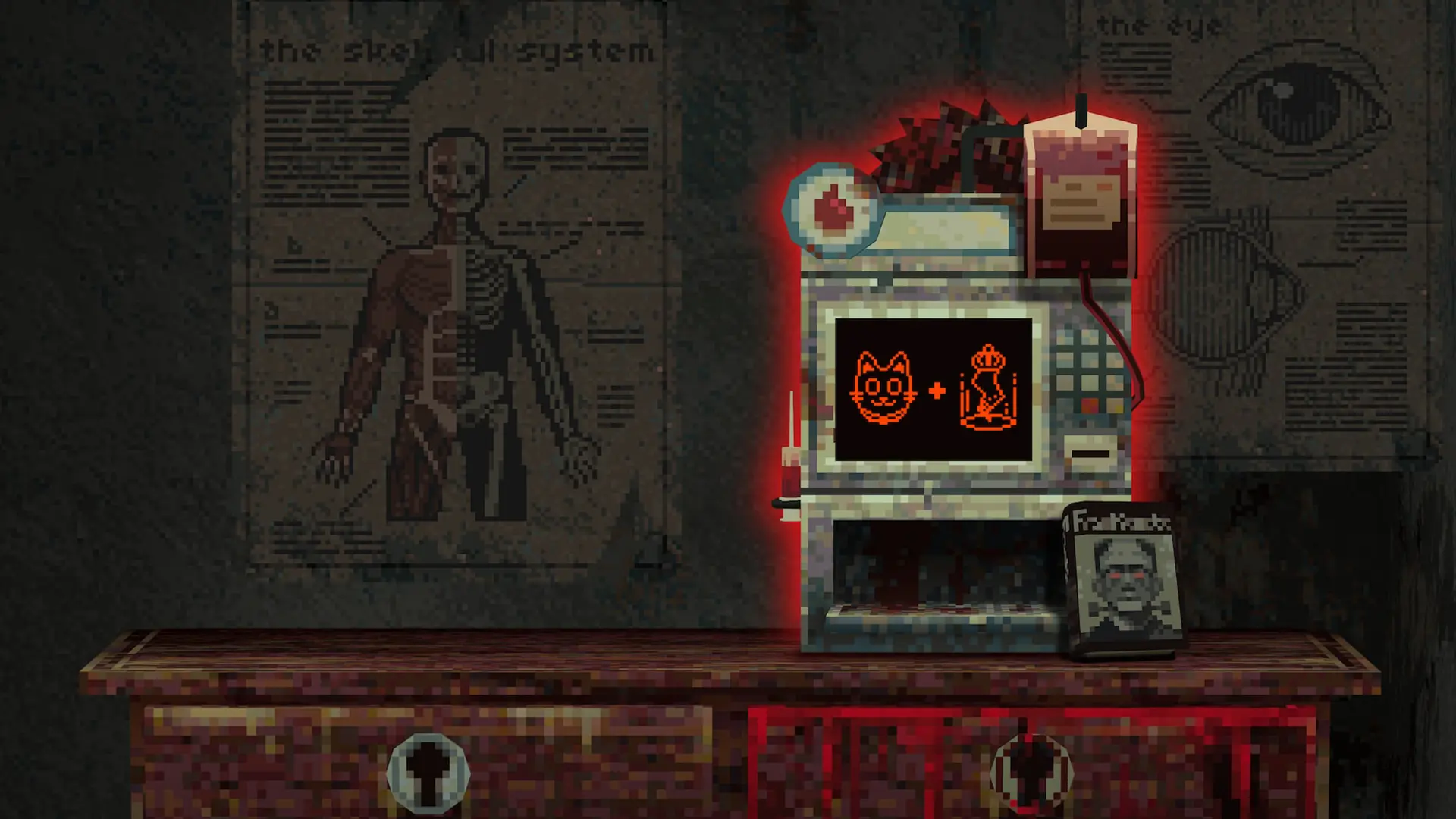
Cloverpit is a well-received participant recent glut of gambling/casino-style roguelikes, games that are – for the most part – created and enjoyed in good faith, but do still operate on the same psychological patterns and traps that real gambling exploits. It’s also one of the few that does so with a firmly critical lens on the very idea, in turn positioning itself as a “horror” experience that’s just as much about the pitfalls of gambling as it is an, admittedly, very compelling slot machine game.
Each “run” in Cloverpit seems you trapped in a tiny room, and in this tiny room is a slot machine. There’s also a small shop, some drawers, a telephone, a computer, an ATM and a toilet, but the slot machine is what will ultimately determine whether or not you leave this room. A disembodied voice commands that you gamble your meagre starting funds in order to make increasingly-unachievable “Deadline” payments, lest your fate lie in the seemingly-endless pit under your feet. With only a limited number of pulls in each Deadline, the only way to cheat that fate is to get incredibly lucky. Or, well, cheat.
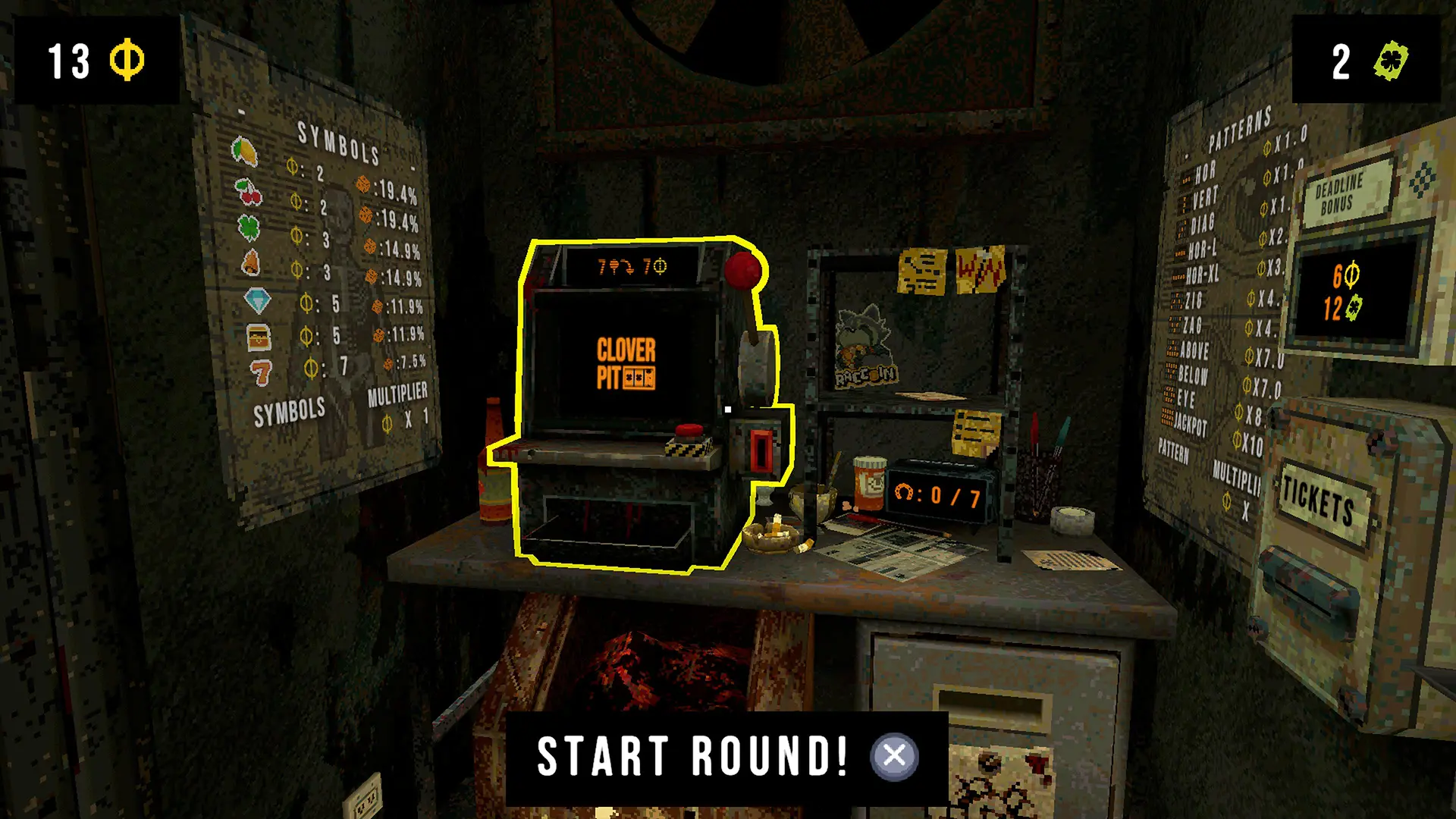
The main ways to rack up big bucks at the slots are through manipulating both the odds of certain symbols appearing and the values assigned to either the symbols or the consecutive patterns that trigger a payout. This is done through a few avenues. Lucky Charms, which are purchased using a secondary currency of tickets, sit on the table next to you while you play, triggering or providing passive effects. These are obtained from a shop with a randomised inventory, and only a certain number can be held at one time, so the trick becomes discovering – and successfully pulling – different charms with synergies that cause their benefits to compound or work in tandem to produce useful outcomes.
There’s also the telephone, which rings once per Deadline and offers a permanent or one-off boon from another randomised pool, though these tend to be more broad and don’t (typically) come at a cost. So while you’re at the mercy of genuine luck when it comes to the slot machine, the focus is on finding new and more inventive ways to break it and rig luck in your favour. You’re also given interest on any money banked between rounds, which you can continue to deposit as long as you keep enough to play the machine, and as the stakes for each Deadline grow exponentially, and the threat of landing a “666” and wiping your coffers increases, it becomes yet another strategic layer to consider.
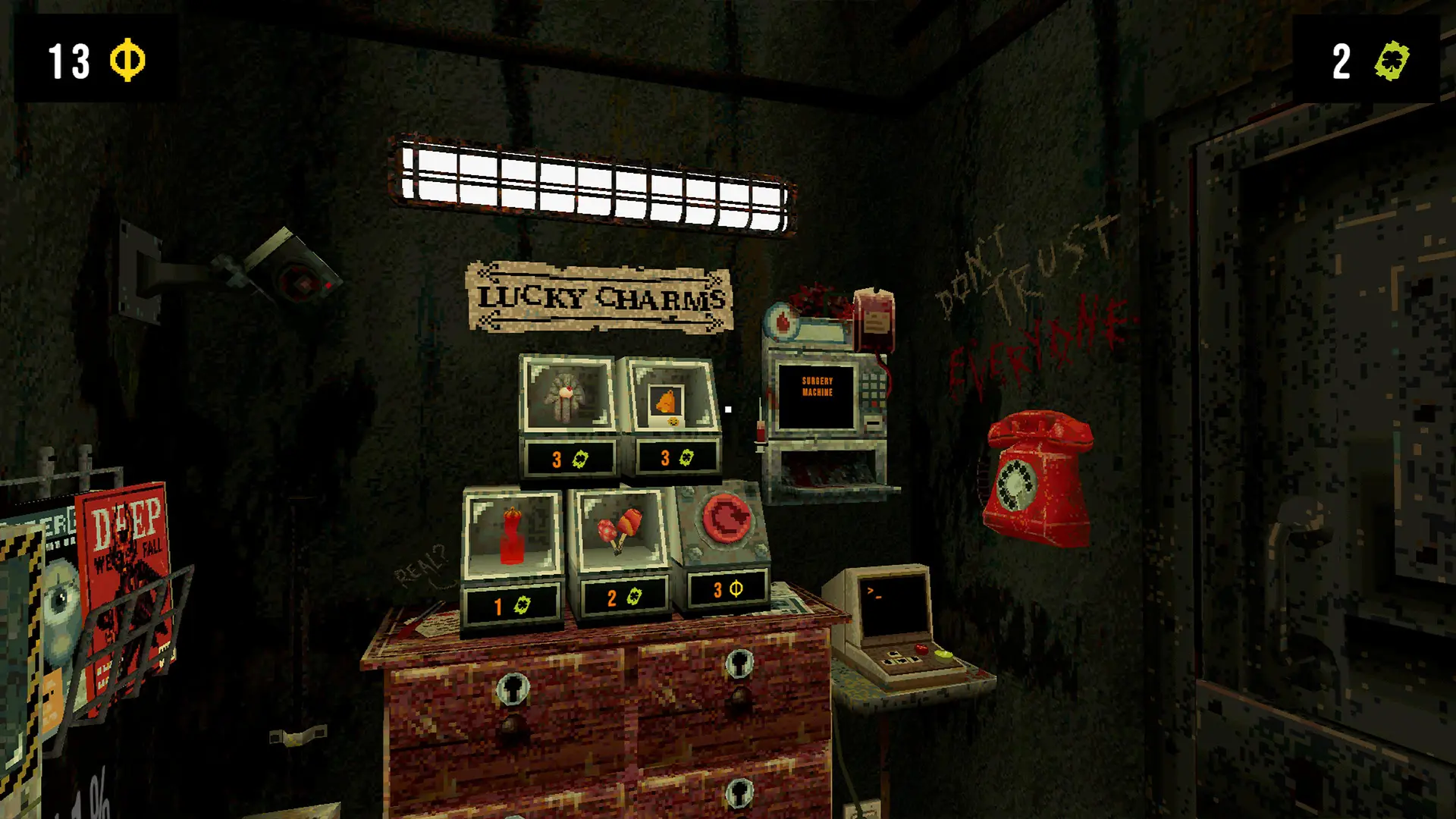
Even with all this in mind, Cloverpit feels exponentially more luck-based than most, and that can come with some level of frustration and despair. But one thing it does differently from other, similar games, is give the player things to think about beyond the core act of spinning slots. There is more to the game than simply racking up high scores on the machine, and through a mix of environmental context clues and cryptic writing you’ll begin to piece together an underlying . I won’t go too deep into it for the sake of keeping that mystery alive, but it doesn’t take a lot of comprehension to look around your claustrophobic and grimy prison littered with unholy imagery to understand the work’s sentiment toward gambling.
The more immediate benefit to having some semblance of a diegetic framework is that it also creates something for the player to overcome, and so Cloverpit becomes something to be solved. With a few runs under your belt, things begin to change in ways that imply some kind of escape, and your attention shifts away from how to beat the machine, to how to beat whatever’s keeping you in front of it. As an allegory I wouldn’t call it inspired, but the atmosphere – propped up as it is by lo-fi, early-era 3D visuals and uncanny sound design – makes it plenty compelling.
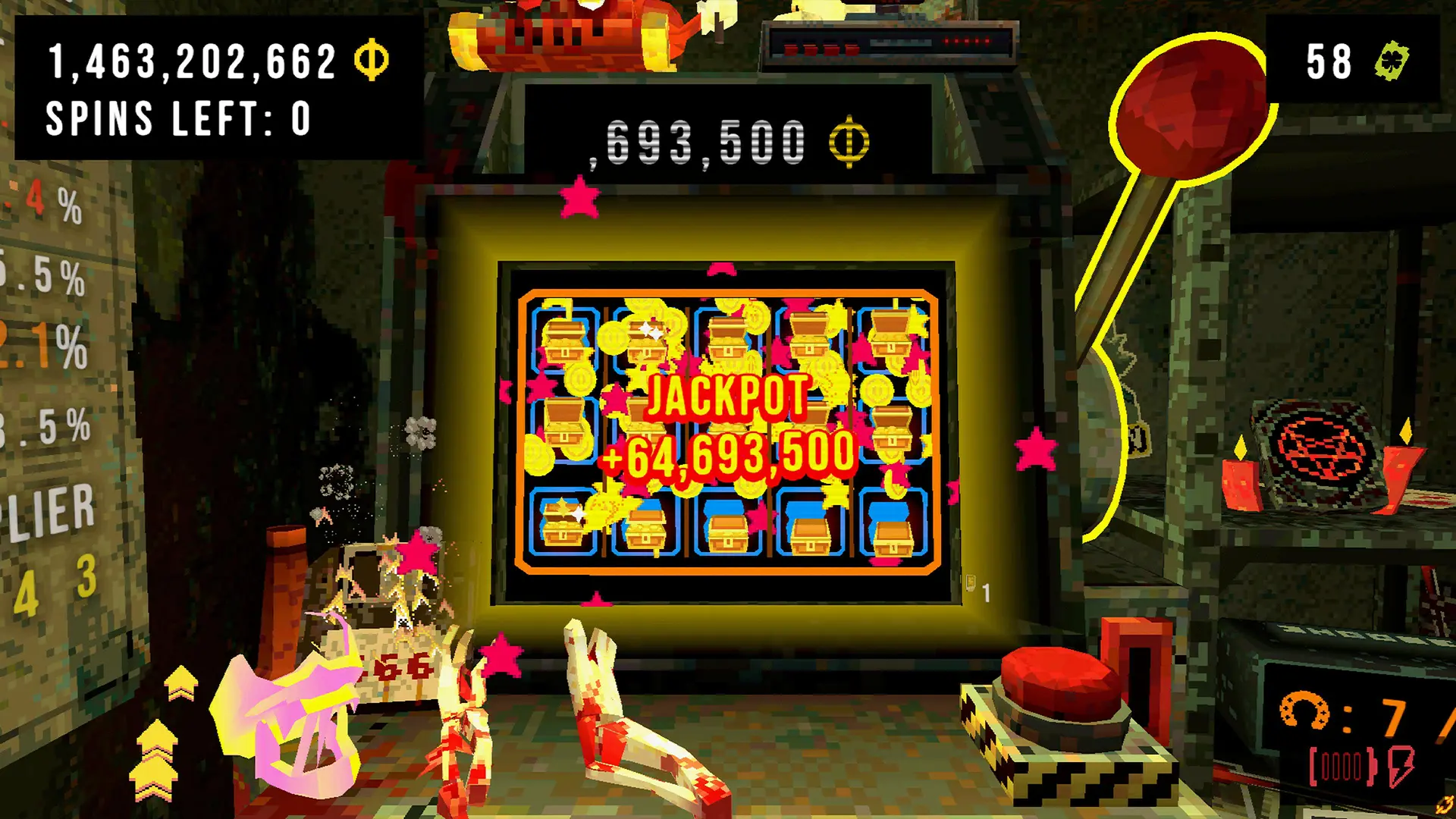
Some my lament the lack of guidance when it comes to unlocking Cloverpit’s darkest secrets and seeing it through to a real conclusion, but (and again without entirely unpacking an experience worth figuring out on your own) in taking the metaphor at face value it tracks that the answers are far from easy or obvious. They’re also hugely skewed toward luck, perhaps unsurprisingly. The game demands risk and withholds reward, with even the promise of breaking the machine to spit out riches turning out to be something of a falsehood. The odds to truly overcome the thing are even more stacked against you, the margins razor-thing and the conditions cruel.
Now, the entire reason we’re publishing a review of Cloverpit in the here and now is that the game is newly launching on PlayStation and Switch, opening up its tempting horrors to whole new audiences. This has been my first time playing, on the PS5, and overall the experience has been smooth sailing from a technical and UX standpoint. My only, very minor gripe is that a lot of the game’s interactions could have been mapped to button presses rather than tied to occasionally-cumbersome menus. I’m mostly asking for dedicated inputs for pulling the slot machine’s handle or hitting its power-up button, a small change that would make the actions immensely more satisfying.
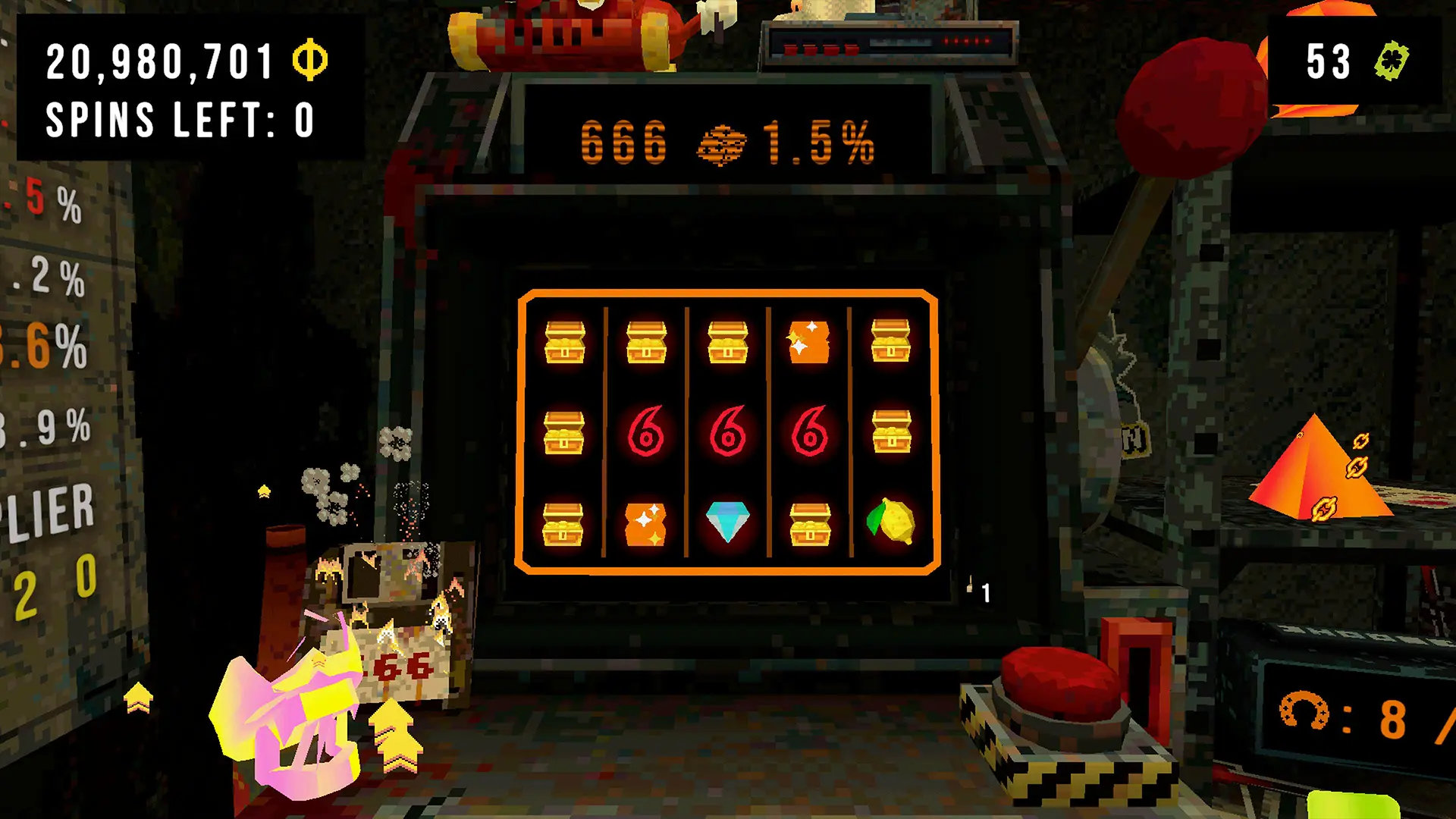
I went into Cloverpit expecting something akin to Balatro, a score-chasing roguelike driven by the fun of gaming the odds to make ever-increasing numbers appear. And I can imagine I’m not alone. So, when the reality sets in that it’s not concerned with the fun of winning, but rather the vicious and repetitive cycle of losing everything. It doesn’t simply deploy psychological hooks as mechanics, it shows you in no uncertain terms just how insidious and inescapable they truly are, and then sits you down and asks, “So, do you feel lucky?”
Reviewed on PS5 | Review copy supplied by publisher
Like our content on covergeek? Hate dodgy AI summaries? Click here to add us as a Preferred Source on Google and see our posts more often!


Born into the world of video games through SEGA, and in particular Sonic the Hedgehog, Kieron’s gaming tastes now consist of the latest, shiny AAA thing, an indie darling or two, and an embarrassing number of hours of Balatro.