

I’m going to be upfront with this – after playing roughly an hour of Final Fantasy Resonance in an exclusive preview build of the game, and then following it up with the publicly-available demo that dropped during last week’s PlayStation State of Play, I still have very little idea what the game is about. That’s through no fault of the game, or anyone involved in putting together these early tastes of it, it’s entirely on me for having the attention span of an iPad kid trying to watch a vertical video that doesn’t have Subway Surfers footage running underneath it. I know there’s something about crystals, this being a “classical” take on the series and all, plus some airship stuff and folks fighting over who gets to be the Cid of this world, but that’s as far as I go.
Thankfully, I can worry about that when the game launches next month. I already know everything I need to know to be sure I will enjoy the hell out of this game, and that’s thanks to its excellent spin on Final Fantasy combat, some of the best-looking HD-2D visuals to come out of Square Enix so far, and of course – my boy Squall.
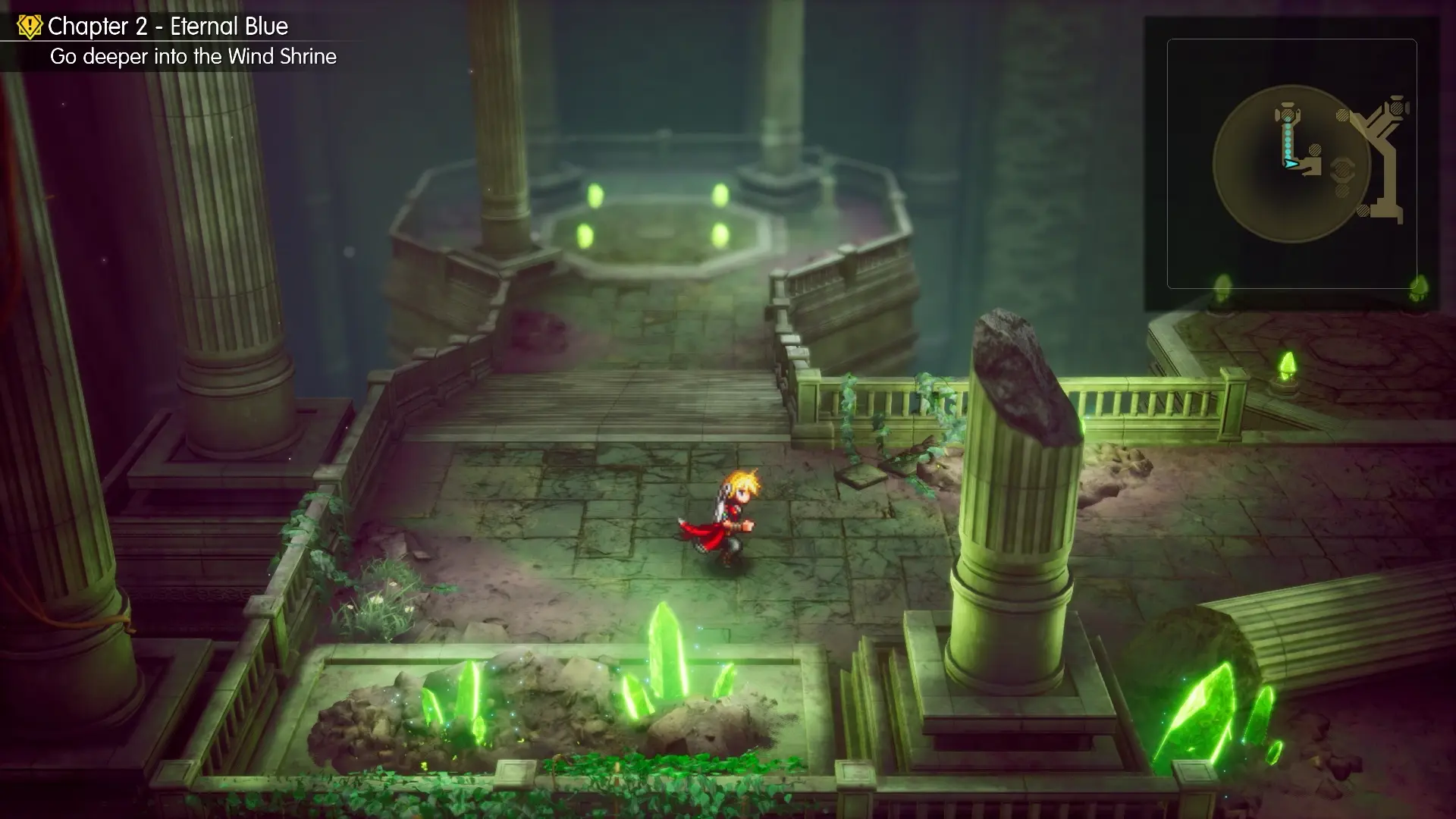
But let’s go from the beginning, which, ironically is not the beginning. Before sampling the downloadable demo of Final Fantasy Resonance that’s freely available to everyone right now, I was invited to play a behind-closed-doors demo of a later portion of the game. Set around the second chapter, it sees me venture into the “Wind Shrine” in a bid to find and protect the Wind Crystal – one of those elemental gems that are so frequently of grave importance in a Final Fantasy joint. My party of Rain, Lasswell, Fina and Lid (yep, those are the names) are out on a royal mission to secure these vital crystals after one has already been shattered by the Veritas of the Dark. So far, very standard stuff.
For as quaint as the storytelling is here, though, and modelled on the Final Fantasy Brave Exvius mobile game that Resonance is “remaking,” the game’s combat is a refreshingly modern take on the turn-based fare of old. It’s a slick, snappy and strategic system that lifts a few ideas from a range of prior Final Fantasy titles – a big one being the concept of Stagger. I’ll admit, I rolled my eyes a little when I first saw that word pop up in my demo. It feels nigh-impossible to get a new FF game these days without some form of a Stagger mechanic, but it’s actually quite a neat inclusion here.

Taking advantage of enemies’ elemental weaknesses or making good use of appropriate abilities helps deplete their Stagger bar, and successfully Staggering them not only delays their go but grants the attacking party member a bonus move in the current sequence of turns. Even better, Staggering every foe in your sight triggers a special bonus phase where your entire party comes together to attack in sequence and activates the titular “Resonance” move from one of your Visions (more on those in a bit). It becomes a game of not only thinking about which of your attacks and abilities is best placed to whittle down a foe’s health but which might temporarily drop them and afford you some extra moves to finish the job right.
Each of your characters takes on some form of a traditional Final Fantasy role, but they’re also augmented by whichever Vision you choose to equip. Visions are the engine of Final Fantasy Resonance’s nostalgia vehicle, comprising of pixel art takes on iconic Final Fantasy characters from across history. In my demo, those are Warrior of Light, Terra, Cloud and Zidane, but the cuts will run much deeper in the full thing – a nice holdover from the gacha elements of the game’s mobile foundations that won’t require any simulated gambling to engage with.

These Visions act as something of a de facto job system in Resonance, a second party to their assigned hero and therefore able to take their own individual turns to use unique abilities suited to their character. Mixing and matching these Visions is going to be essential to progressing through the game’s greatest challenges, and thankfully you’ll be able to learn and retain some of their abilities to use even after swapping them out. Best of all, their more powerful moves come with flashy pre-rendered CG cinematics that look straight out a PS1-era FF, which I’m very much here for. Same goes for the Summons, which are present and accounted for here and similarly come with their own FMV intro sequences, before sticking around the battle for a few turns and dishing out some autonomous justice. Our preview build only had Siren as an available summon, but that was more than enough for my Final Fantasy VIII-loving arse.
There’s maybe less I can say about Final Fantasy Resonance’s structure and exploration outside of battle, as this Wind Temple segment was a relatively straightforward early-era dungeon with just the requisite number of corridors, elevators and lightly-hidden treasures to navigate in-between random battles. By the time I reached the satisfyingly-challenging boss in this area, I’d seen everything I needed to of its dungeon gameplay.

Instead, what truly wowed me in all of this is Resonance’s HD-2D presentation. It’s an idea we’ve seen out of Square Enix plenty of times at this point, but it’s taken that much further here. The game’s character sprites, whether original or riffing on heroes’ past, are excellent across the board and sit well within the proper 3D environments. But it’s the animation and camera work that really ties this visual suite together, with lots of lighting, effects and dynamic angles that we really haven’t seen the likes of in a HD-2D title to date. Cutscenes benefit hugely from some creative camera work and plenty of neat depth-of-field effects, it all truly needs to be seen to be believed.
And before I wrap up, a shout-out to everything I’ve heard of Noriyasu Agematsu’s musical score so far. Brilliant stuff.
I feel like I’m barely scratching the surface of what excites me about Final Fantasy Resonance’s core gameplay ideas, so far. And that’s before really digging into its cast of characters and the story being told. The mobile original could cynically be described as a vehicle for monetising series nostalgia, and could have been left to the annals of time after its shuttering, but signs are incredibly promising for this large-scale reimagining – it may wind up being a killer HD-2D debut for the series.
Previewed at an event hosted in Sydney, with covergeek‘s flights covered by Bandai Namco Australia.

Born into the world of video games through SEGA, and in particular Sonic the Hedgehog, Kieron’s gaming tastes now consist of the latest, shiny AAA thing, an indie darling or two, and an embarrassing number of hours of Balatro.