
Finding myself in the throes of espionage, war and nonsensical chicanery, I entered Titanium Court, a mere fawn in the headlights. Trapped in this unfamiliar fortress, surrounded by strange folk speaking in an uncanny tongue, my only goal was to escape.
This is a game that revels in the bizarre and philosophical. With the menagerie of genres mashed together, it can be hard to wrap your head around exactly what is happening in the Court at any moment. All you’re told is that there’s a forever war and that you’re in charge. Morning, War, and Night, I toiled away, looking for answers and a way to get home.
Titanium Court is full of odd occurrences. Signs and paintings appear at random, resembling something familiar to you, like a basketball player’s portrait or a picture of a van. The faeries debate on the meaning of these artefacts, usually landing on something far grander than what reality dictates. Magic is imbued in everyday things like advertisements and simple written passages. There’s a talking cat.
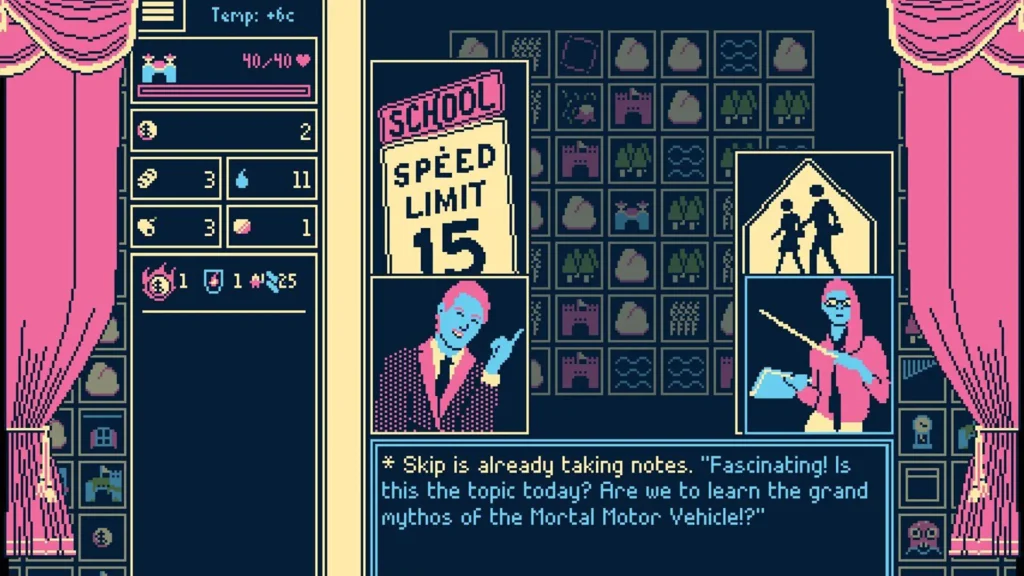
Stranger still, the world seems to unravel and stitch back together at your command, allowing you to manoeuvre the battlefield around as you see fit, willing you to victory.
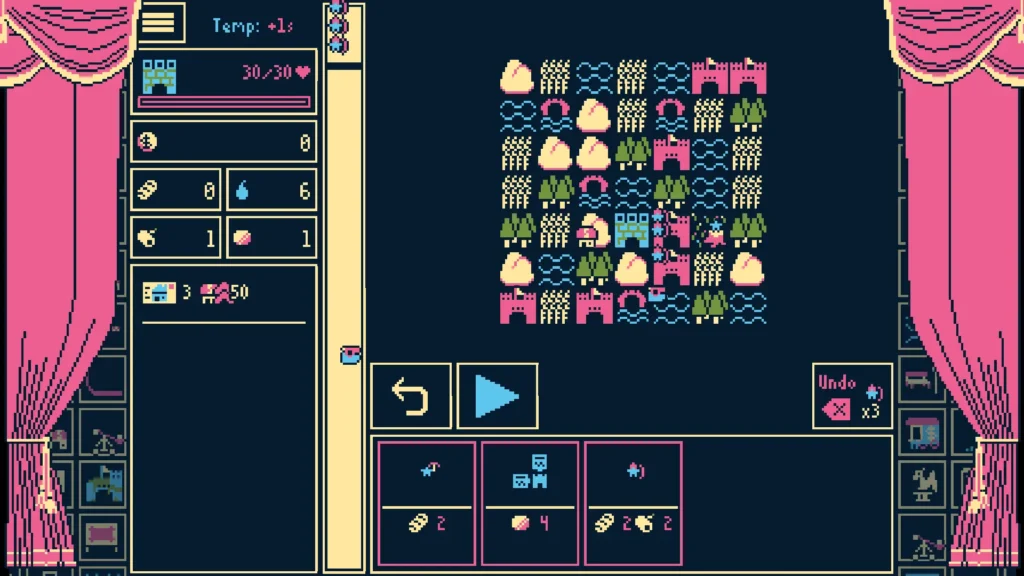
This is where Titanium Court’s match-three/tower defence mashup plays out, splaying a grid of resources and enemy courts for you to manipulate before the big battle. There’s an intended balance between gathering resources and mitigating enemy presence evident during this phase of war. Each swipe of the board to line up three or more icons could earn you crucial supplies to build an army, it could wipe enemy castles off the grid, or simply move your own to a more protected space – every action depleting a time gauge until the next phase begins.
Despite the intent, I almost always found it most advantageous to cut myself off from spawning enemies and manage with what little resources I did have. This varied, of course, depending on what my goals were for each war and which job I had selected before waging it – but nine-times-out-of-ten, my surefire way of reaching the end of a run would be to cower from danger.
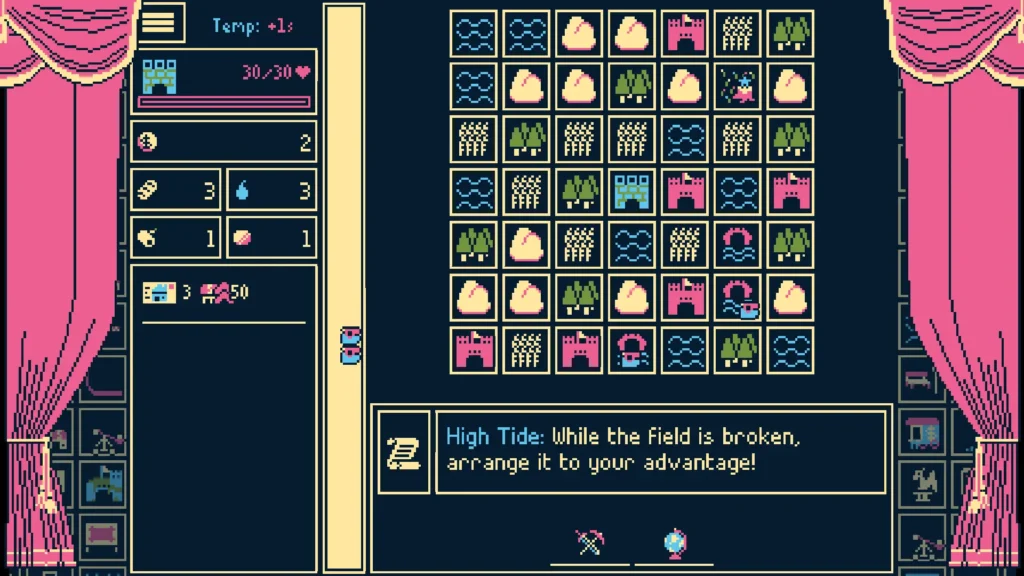
This phase is at its best when you get to line up dominoes over multiple runs, only to knock them down in the most satisfying way to complete one of your larger to-do list items. I’d also be doing the game a huge disservice if I didn’t mention the little tune that accompanies most of these bouts, immersing you in positive vibes and the twangisest guitar solo from the game’s very creator, AP Thomson.
After a war has been either won or lost, the world vanishes, leaving only the court to remain hanging in space.
The second half of Titanium Court proceeds with you wandering the castle and trying to learn its secrets. Unfortunately, I spent the vast majority of the time wandering the halls just trying not to get lost.
Do I walk up the stairs? Or down the ladder?
Left or right? Haven’t I been here twice before?
If any faeries were to watch me meander about, they’d think me enchanted.
Once you’ve spoken to some faeries and discovered an odd thing or two each day, it’s easy to drift into a mundane cycle, especially if you aren’t making any headway on your journey outside of the Court.
Early on, I was told that all the inhabitants of the Titanium Court were immortal. “Neat,” I muttered. It allowed me to wage war every day with impunity, it mattered not whether I won or lost, or even how many casualties there were. Life without Death is without purpose, nothing matters.
Wake up. Eat breakfast. Go to War. Lose War. Go to bed. Wake up…
I found myself checking out, caring very little for what happened around me. My goal to get out of this place became even stronger and all that mattered was my goal.
Titanium Court loves to roll in metaphysics, with a character or two astutely aware that they’re a part of the game. Mostly performed for comedic effect, this meta-talk can come out in some fairly philosophical moments.
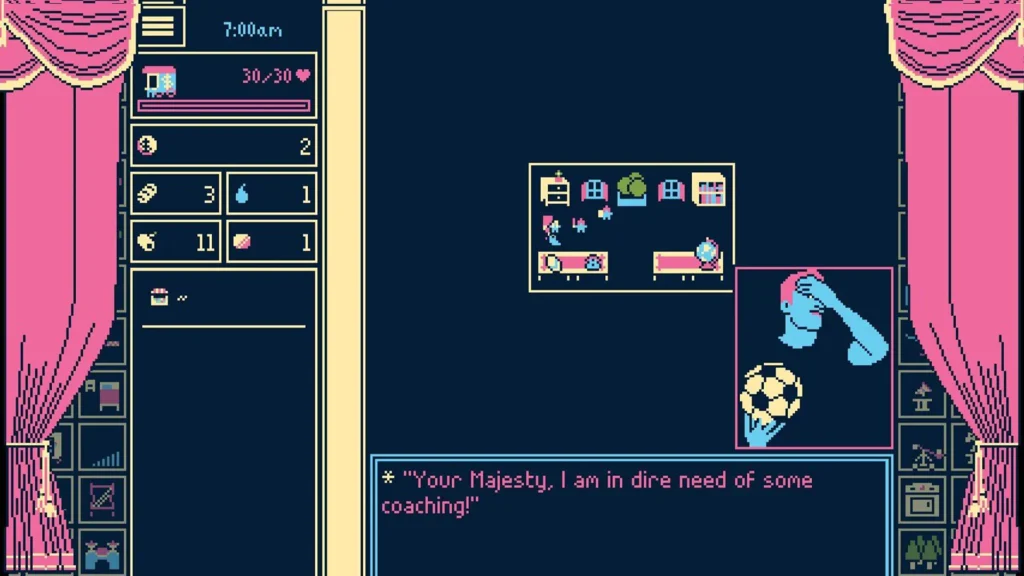
One of these self-aware faeries, Puck, will answer any burning questions you have about the Court and events surrounding it, but never the same question twice. They know the game, they’re aware that they’re a pre-programmed string of code, they’re also aware that the player’s presence is a detriment to the Court itself.
Puck, and by extension, the game itself addresses the player. It poses the question, how much of what’s happening in Titanium Court is your fault up to now? Your arrival is the one that kicks off the war in the first place, the fact that you ended up at the castle meant that the Queen had been found and that battle could commence. The game asks you in the beginning to take responsibility for Titanium Court, but you misinterpreted the request. It’s no longer asking.
It’s a brief moment in the whole experience, but the part that stuck with me the most. I was being asked: Am I a benevolent god or a careless one? How much of the onus was on me to stop things collapsing further? Was my personal satisfaction of getting to the end credits worth the irreversible unravelling of the Court and its subjects? Would Titania continue to be subjected to Oberon’s scheming if not for the audience that demands it?
During the game’s tutorial, it’s mentioned that everything taking place from that point forward is an incomplete stage play. Both the writers and stage performers are racing to complete their work the fastest. An unassuming, early tooltip explains an integral part of the game, “Much like life, every move you make will deplete some of your remaining time!”
It may not have been the part you thought.
Reviewed on PC | Review code supplied by publisher