
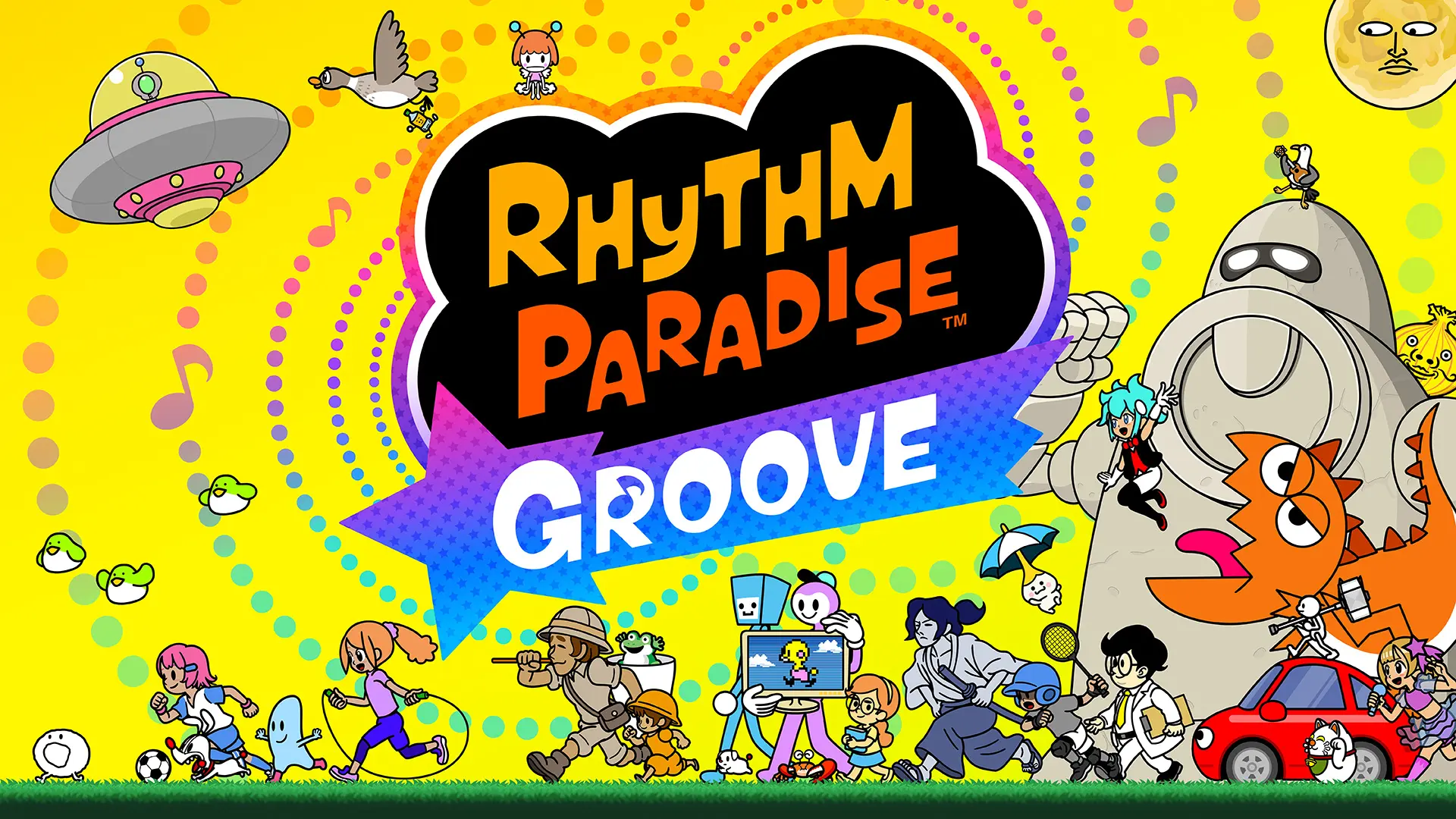
There are two titles I played on my Nintendo 3DS more than any other, and both just happened to be rhythm games. The first, which I reckon I’d sunk quadruple-digit hours into by the end, was Theatrhythm Final Fantasy (I’m including the sequel in that number). But whenever that threatened to become tiresome, I’d switch things up with Rhythm Paradise Megamix. It was my first taste of the Rhythm Paradise/Heaven franchise, and it wouldn’t be until these past weeks when I’d return to the fold with Rhythm Paradise Groove.
It’s wonderful to be back.

Groove barely skips a beat in its reprise, dropping a fresh batch of 80-odd rhythm games that each pair a delightfully catchy track from returning composer, Tsunku, with a deceptively simple premise borne of minimal button inputs. Whether it’s slicing up airborne vegetables for a home-cooked meal, bouncing fruit off of a set of glistening biceps or firing off sequences of high-fives over a bunch of stock photos of a rocket launch, your success depends on how well you can recall audio and visual cues to press just one or two buttons in the proper time. A tutorial precedes each game, getting you to grips with what you’ll be asked to do against some generic tutorial music, without spoiling the actual fun to come.
The vast majority of the included games are fantastic in their own way, whether its the simple catchiness of the soundtrack, the creative ways the game will try to trip you up or simply the absurd concepts on display. There are a couple that I didn’t especially click with, either because I couldn’t quite grasp the flow (I hope to never look at another non-crushed can again) or it just wasn’t especially interesting, but you only need to get through each with a “Good” rating to unlock the next one. Your perseverance is rewarded with some fantastically fiendish late/post-game levels, too.

The Remix stages remain a highlight, capping off each set of four games with a high-pressure mashup that switches between all of them at a moment’s notice, forcing you to remember and execute on four different inputs. The simplicity of controls is crucial here, and lends to some truly excellent moments of harmony where the game will layer one game on top of another as your rhythmic button presses remain perfectly in sync with both. Oddly enough, I often seemed to score better on these tougher mixes than the relevant standalone games, though that may just come down to the idea of being practiced before the main event.
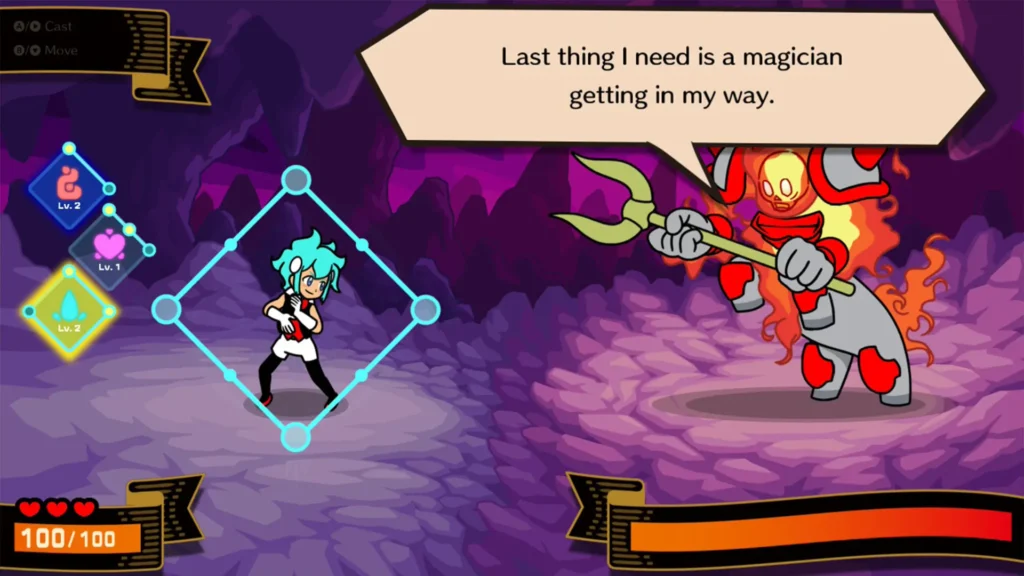
Aside from these staple modes, Rhythm Paradise Groove also includes a handful of extra diversions to mix things up. The big addition is Beatspell, an RPG-esque mini-campaign that tasks you with battling monsters to the beat. Each of your steadily-growing catalogue of spells is mapped to a specific sequence of button presses that must be done on the beat, and the battle plays out in real-time, so it comes down to staying on beat and firing off steady strings of offensive spells while knowing when to switch to a healing sequence. There aren’t too many levels to play through in Beatspell, but they’re slowly unlocked as you earn medals in the regular games, so it’s nice to keep coming back to and is genuinely a lot of fun – I’d love to see the idea expanded on in future.
Multiplayer is also a crucial component here, offering a further ten games (each with three stages) to play with/against friends on the same screen. These are all a lot of fun, with some simply splitting up a “regular” rhythm game between each person but others leaning a bit more into the multiplayer aspect – like making you work together as ninjas defending against incoming arrows or coordinate to set up successful volleyball spikes. Cake Wait remains the ultimate score-settler in my house.
Simplicity is the song that Rhythm Paradise sings the loudest, and it’s an intensely important part of making the experience work as well as it does. The UI is minimal, the buttons required to play are few, and there’s not a whole lot to play with in terms of settings or customisation. This does create some pain points the series, like a lack of granular feedback on how well you’re playing, which can make it hard to figure out where you need to improve. It also seems like a no-brainer to have included a very basic reminder of the button prompts for each game in the pause screen, rather than forcing me to quit out and re-sit the tutorial if I forget any one of the dozens of different concepts here.

This lack of finesse is especially evident when playing in docked mode on a TV, where video/audio latency is a real issue. There’s a built-in calibration tool, but again it’s overly simplistic and doesn’t allow for deeper tweaking. My own efforts to calibrate to either of my TVs at home seemed to always result in overcorrecting to the point I felt like I was pressing buttons from the future, so I eventually gave up and stuck to playing in handheld mode with wired headphones. It’s a game with roots in the handheld scene and still makes the most sense played that way, but it’s annoying that the TV experience is so iffy as is, especially when the multiplayer is so much fun.
Still, for these few faults, there’s just no other Nintendo-led series that captures the kind of infectious strangeness that Rhythm Paradise does – outside of the WarioWare games. It’s a delight to be back here, and to see that there’s still plenty of life and music left in this silly franchise.


Born into the world of video games through SEGA, and in particular Sonic the Hedgehog, Kieron’s gaming tastes now consist of the latest, shiny AAA thing, an indie darling or two, and an embarrassing number of hours of Balatro.