
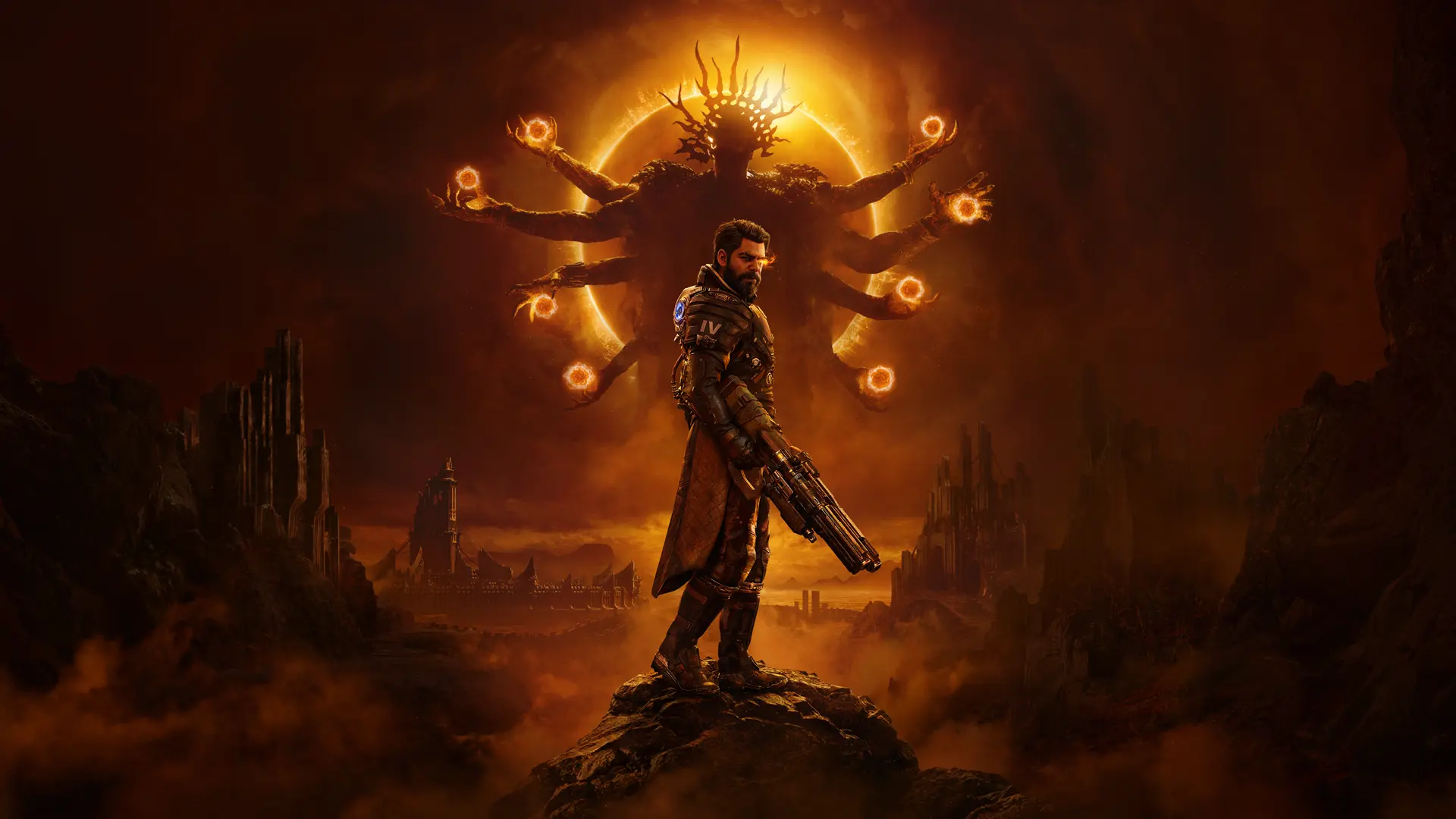
Carcosa is a planet rich in an incredibly unique and valuable resource known as Lucenite, and you don’t just discover this sort of thing without sparking a corporate interest. And so we meet Arjun (played by the very handsome and talented Rahul Kohli), an Enforcer with a vastly powerful company by the name of Soltari, sent to Carcosa along with a full complement of crew to check on the progress made by the three expeditions before them. On arrival though, things aren’t quite what anyone expected, and the other Echelon crews are nowhere to be seen. So, with his own team dwindling in number and a personal interest that he’s kept hidden from his peers and employer, Arjun must set out into the wilds and ruins of this world, littered with perils, traps and all manner of flora, fauna and machines ready to kill him.
This is the topline setup for Saros, the next game from Housemarque and its first under the official PlayStation Studios banner, leading to the studio’s biggest, richest and most fully-realised work, a culmination of everything that’s come before. And, although arguably a spiritual successor to 2021’s Returnal in a lot of ways, another fresh IP in the stable.
I’ll try my best not to consistently compare the two, but for those who’ve played Returnal, a lot of Saros should feel immediately familiar. The game builds on the visual language established in its spiritual predecessor, adding to the thematic palette of blue and red with a third colour – yellow. There are numerous narrative implications to yellow in Saros, but it’s also a crucial part of survival on Carcosa. It means that the bullet-hell projectiles that define these games now come in three hues, and learning to navigate each one is the only way to get by.
Blue projectiles offer power over the threat of the yellow eclipse and its army of organic and machine hostiles. These will hit you for damage, but can also be dashed through or absorbed by your shield, should you employ it at the right time, which in turns powers both the shield and your devastating Power Weapons, creating a need to put yourself in harm’s way to continue your defensive and offensive options. Red, on the other hand, can’t be dashed through or blocked, but can eventually be parried, sending them flying back towards the enemy and clearing out any other projectiles in their flight path. Another, even more fraught, bit of risk and reward.
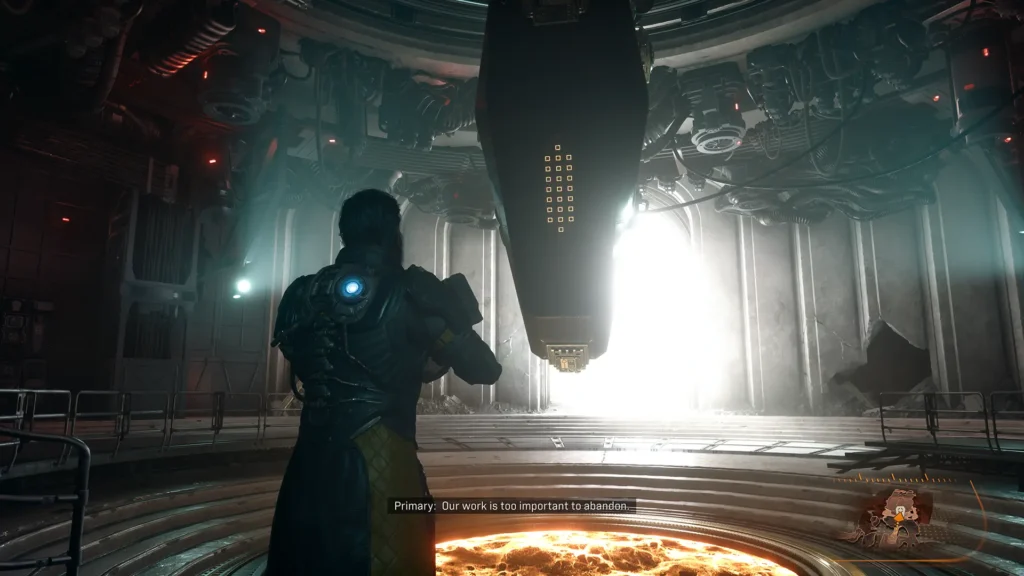
Yellow, though. These are the nasty ones. They can be dashed through, or blocked, but letting them hit either Arjun or his shield adds an increasing amount of ‘corruption’ to his suit, restricting his maximum health and applying further negative effects if left unchecked. These don’t appear by default, with regular enemies usually only employing the other two colours, but everything changes on Carcosa when the Eclipse comes…
An Eclipse in Saros isn’t just one of those things a US President might look directly at in spite of a lifetime of being told not to. It’s a phenomenon that fundamentally changes the landscape of Carcosa, rendering it even more deadly, whipping its inhabitants into a frenzy, and even distorting space and time.
As the story plays out, you will learn even more about the effects of this particular planet’s sun, but with boots on the ground it’s the arrival of yellow corruption that presents the most immediate danger. It starts out as a way to add extra spice to the game’s challenge, letting the player trigger an Eclipse to instantly morph the world into a deadlier one that yields higher rewards, but eventually your hand will be forced and only the Eclipse will bring any hope of Arjun reaching his goal and finding some answers. Yay!
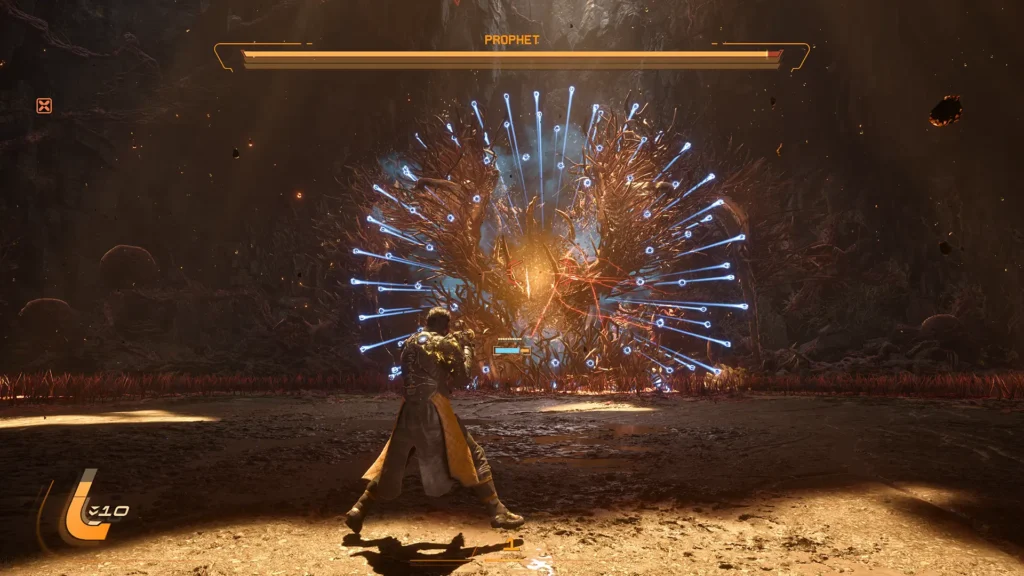
To combat all of this, Arjun has access to a number of distinct weapon types, and within those yet more variants to keep things interesting even after you’ve settled on a favourite. Hand cannons, shotguns, rifles, crossbows and chakram launchers all feel markedly different in the hand and all benefit from different subsets and added, randomised modifications when you pick them up. You can also find and equip temporary artefacts that augment things further, though during an Eclipse these will come with potential side effects. And as you press on, defeating enemies and collecting Lucenite, a growing proficiency level dictates the potency of weapons and gear you can pick up.
The game’s tagline of “Come Back Stronger” manifests itself in a number of ways, principally when it comes to its rogue-ish cycle of heading out into Carcosa and progressing as far as one (or, eventually multiple) deaths will allow before returning to your base at The Passage. Whether in victory or defeat, coming home means resetting your stats and gear, but keeping either or all or a portion of your collected Lucenite. This is then spent on a massive skill tree to increase your baseline effectiveness across a few key areas, meaning that every time you head back out you’re doing so with at least a little more oomph at the outset.
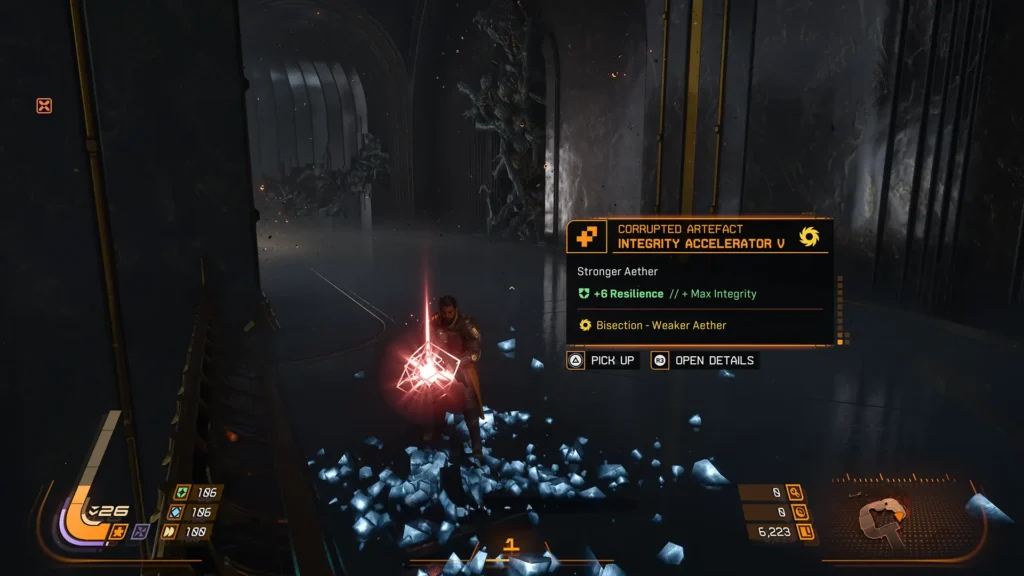
And when you get stronger in Saros, boy do you feel it. While the game allows you to teleport right to any biome (sorry, but it’s the term the game uses) you’ve managed to reach at least once – a massive boon for those who never quite managed to crack a full run in Returnal – the further back you start the more you’ll have accumulated by the time you make it back to your previous finish line. This makes for a really comfortable push and pull where, sure, it might be quicker to jump in where you last left off, but you’ll start out much more fragile than if you re-ran the prior areas, changing what would have felt like a slog to go from square one each time into a workable strategy for getting ahead.
I do wish that these individual biomes in Saros were a little more distinct and interesting in their layouts and designs. They all have some kind of flavour, of course, and Saros is an incredibly handsome game sporting a lot of cool PS5 visual and audio wizardry to really lock you into the moment, but there’s less between them that changes how you play and interact. I think back to the Derelict Citadel or Abyssal Scar in Returnal and how much I had to re-learn or re-frame my methods to suit their unique landscapes, and I don’t get a lot of that here. Nothing is bad, but with maybe one exception nothing really stands out.
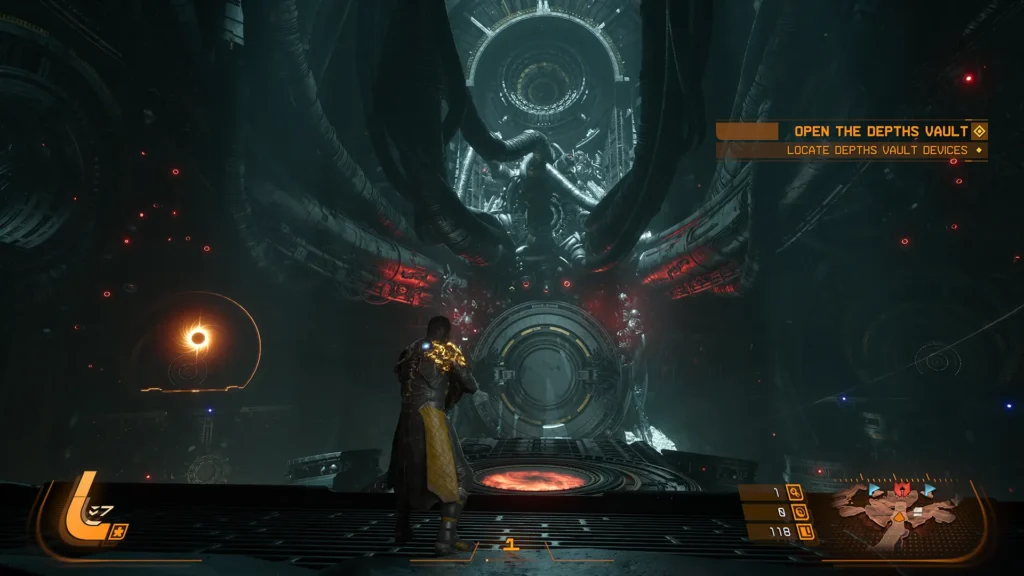
That’s well and truly made up by the moment-to-moment action, though. A complete run from the front doors of The Passage to the end point of the game should take most around two, two-and-a-half hours depending on how many side paths you stray down, and I can’t begin to describe how exhilarating it feels to be mowing down hostiles at the tail end of that with high level weapons and a full complement of buffs. It’s a complete moment of catharsis after walking on egg-shells, getting by with slivers of health and sweating every last particle that brushes by you and threatens to take you out.
I’m going to borrow from the game’s own marketing here, because it is unfortunately completely true, but where Returnal married third-person shooting and ‘bullet hell,’ keeping Selene constantly on the edge of survival, Saros is more of a bullet ballet. When you’re powered up and skillfully dashing, blocking and parrying all three colours of projectile in a flow state, it’s truly something to behold. Housemarque has achieved such a tight balance between movement and gunplay that Coming Back Stronger feeds not just into that semi-cyclical loop, or Arjun’s story, but into your very mindset going into each encounter.
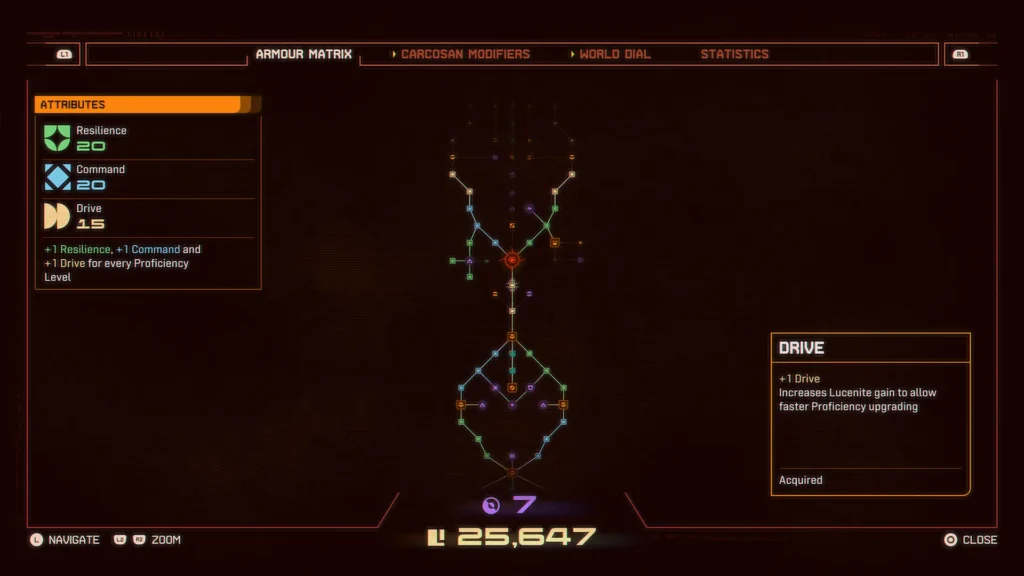
Then there’s the Carcosan Modifier system, a way to tweak your runs even further with boons and banes to make certain aspects easier or harder. These are all entirely optional, but also carry their own weight on a scale that measures the balance of your choices – you’re free to tip that balance over to making things extra-hard on yourself, but you can’t activate too many positive effects without giving something up in return.
I think what’s worth celebrating when it comes to the Carcosan Modifiers is that this is a system designed not just to be a fun way for players to mix up their game, but with accessibility front-of-mind. The game allows players, should they choose, to turn off that limit that dictates how many positive buffs they can apply, essentially allowing you to switch them all on at full strength for a far more approachable experience. This doesn’t feel like an afterthought, it feels like a marriage of game design and inclusive intent, each complementing the other, and flies in the face of any argument that intentionally challenging games like this don’t play nice with difficulty modifiers.
This deepening and widening of what the studio had established in Returnal extends to its storytelling aspirations, as well. For starters, Arjun isn’t alone on Carcosa, with multiple surviving members of Echelon IV setting up camp in The Passage and offering the opportunity to expand and exposit on everything that’s going on. I had initially worried that this might fundamentally change the sense of isolation and growing madness that made Selene’s journey so compelling, but what’s here instead is just as effective and only becomes more so over time, consistently keeping you on the edge of any understanding or intellectual victory in much the same way that the rogue-ish loop does for the gameplay side of things.
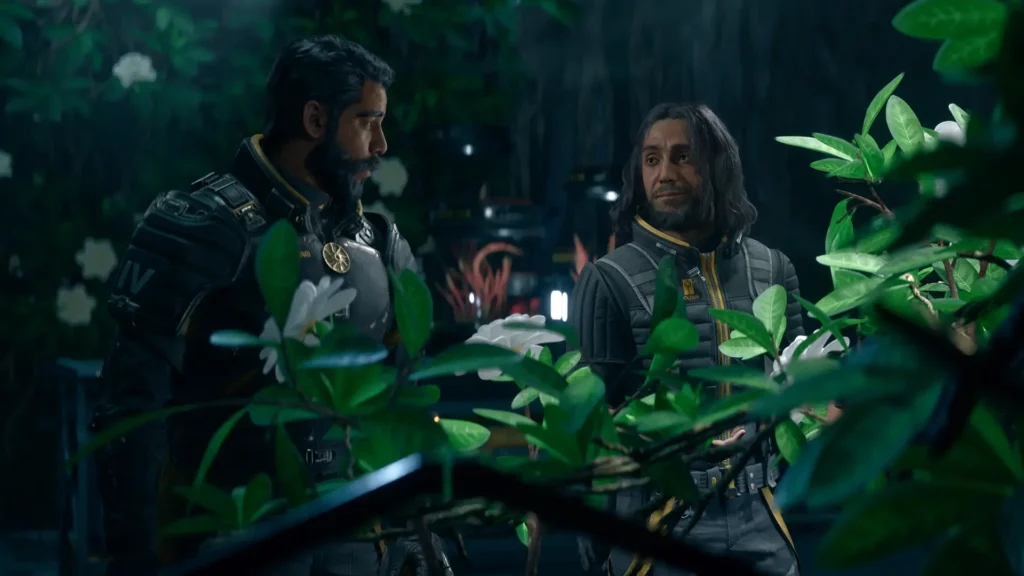
There’s a little bit of friction and occasional inelegance as the evolving story attempts to maintain continuity and confluence while respecting how quickly or often an individual player will travel back to home base. Sometimes, this means halting your progress involuntarily, alive or not, so that you can be shown the next major story beat, other times it means giving you the freedom to absolutely smash a marathon run at the risk of you missing moments or conversations that would’ve happened if you’d died a bit more. It also means your delivery of a lot of this stuff is through very rudimentary character conversations that feel a lot cheaper than everything else around them.
But it does eventually settle into something compelling, and a pattern that begins to seep in over time – though I’m holding back for fear of giving too much away – is that Saros is a game of costs. And it’s a game of worship. It’s a game that asks us what it is that we worship, and what that worship demands of us. It might be family, friends, lovers, a deity, an idea, a corporation. We devote and we better ourselves for the benefit and the approval of who or what we worship, but that will always require sacrifice. And so while Come Back Stronger is a great motivator for heading out and braving the harsh, twisting lands of Carcosa and its deadly Eclipses, Saros also asks the question – what will be left to come back to?
Reviewed on PS5 Pro | Review code supplied by publisher


Born into the world of video games through SEGA, and in particular Sonic the Hedgehog, Kieron’s gaming tastes now consist of the latest, shiny AAA thing, an indie darling or two, and an embarrassing number of hours of Balatro.